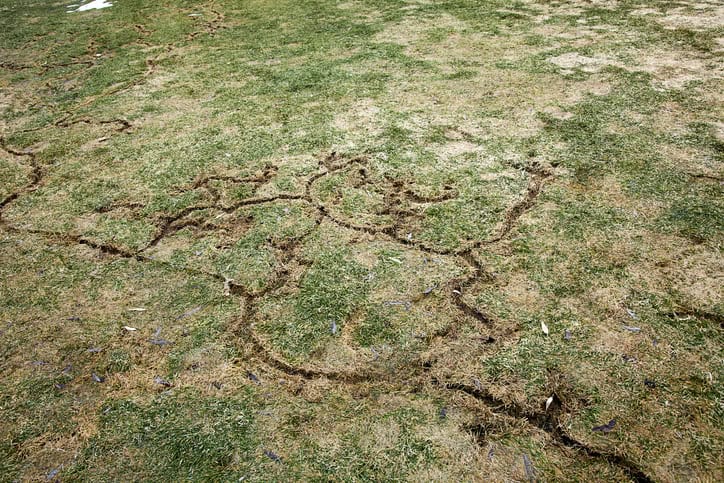
The call almost always comes the same week. The snow finally goes, Northern Kentucky gets four or five days above fifty, the grass starts to green up, and a homeowner in Independence or Fort Thomas walks out to a lawn that looks like somebody ran a weed trimmer across it at ground level. Winding paths of chewed, flattened grass. Bare dirt in the middle of them. Little holes at the ends. It was fine in November.
It was not fine in November. It just was not visible. That damage took four months to happen, most of it under snow and matted-down grass where nobody was looking, and the thaw did not cause it. The thaw only pulled the cover off. Understanding that one thing changes what you do about it, because a homeowner who thinks the damage happened in March goes looking for something that showed up in March. Nothing did.
Key takeaways
- Vole damage in a Kentucky lawn is done over the winter, under snow and matted grass, and only becomes visible at spring green up. The lawn did not get chewed in March.
- Two vole species matter here and they leave different evidence. Meadow voles cut surface runways through turf. Pine voles work underground and chew roots, which is why their damage gets blamed on moles.
- The fastest field test is the hole. Vole holes are clean, open, dime to quarter sized, with no soil pushed out. Mole work leaves pushed up ridges and cone shaped hills of loose dirt.
- Girdled bark at the base of young trees and shrubs is the expensive part of a vole problem. Chewed turf grows back. A girdled Japanese maple does not.
- Voles breed year round in Kentucky and a female can produce several litters a season, so a yard that had them last spring will usually have them again unless the population is actually removed.
What Does Vole Damage Look Like in a Kentucky Yard?
Vole damage looks like narrow winding trails of chewed grass across the lawn surface, about an inch and a half to two inches wide, with the blades cut off close to the soil and dead brown grass or bare dirt inside them. Small clean holes with no dirt piles sit along the paths.
The word people reach for is runways, and that is the right one. A meadow vole is a small stocky rodent that will not cross open ground if it can help it, so it builds a road system and uses it constantly. Every trip along that road it clips grass with its teeth, drops droppings, and packs the soil down. Do that a few hundred times over a winter and you get a permanent trail an inch or two wide that reads on the lawn like a river map from the air.
Look at where the runways go and you will usually see the logic. They hug the foundation, run the edge of a mulch bed, cut along a retaining wall, follow a fence line, and dive under the low branches of a spruce or a row of boxwoods. Cover is the whole strategy. On a Boone County lot with a big open back yard and a landscaped border, almost all the damage will be in the border and the first eight or ten feet of turf next to it, and the middle of the yard will be untouched.
The holes matter as much as the trails. A vole hole is a clean opening about the diameter of a dime to a quarter, punched straight into the ground with no mound around it, and it is usually sitting right in the runway or at the end of it. That absence of a dirt pile is the single most useful thing on the whole lawn, and it is the thing most homeowners never notice.
Why Does the Damage Show Up All at Once in March?
Because snow cover is what makes vole activity explode. Under an insulating layer of snow and flattened grass, voles feed at the surface day and night with almost no predator pressure. The runways are cut all winter. Green up simply removes the cover and exposes four months of work in about a week.
There is a space under a snowpack, right at the soil line, where the temperature holds near freezing no matter what the air does. Biologists call it the subnivean layer. For a vole it is close to perfect. It is dark, it is warm relative to the air, hawks and owls cannot see through it, and the food supply is the entire lawn. So a population that spent October creeping around under the shrubs spends February moving anywhere it wants.
Kentucky winters make this worse in a way that surprises people. We do not get the deep steady snowpack that would let a population run wild for three straight months. What we get instead is repeated freeze, thaw, and refreeze, with matted-down dormant grass acting as cover even when the snow is gone. That mat gives voles most of the protection a snowpack would, for most of the winter, and it lets them work in December and again in late January and again in the first week of March.
So you experienced a lawn that was fine and then was wrecked. The vole experienced a slow, comfortable, four month feeding season on your property. By the time you see the trails, the animals that made them have already bred at least once.
Are These Voles or Moles Tearing Up the Lawn?
Check whether soil has been pushed up. Moles are insect eaters that tunnel, so they leave raised spongy ridges and cone shaped hills of loose dirt. Voles are plant eaters that travel on the surface, so they leave flattened chewed trails and clean holes with no mounding. Grass cut off means voles.
This is the question we field more than any other, and the confusion is completely reasonable, because the two animals do overlap. A vole will happily move into an abandoned mole tunnel rather than dig its own, so you can absolutely have both signatures in one yard. We have opened up plenty of properties in Kenton County where a mole built the highway and voles were using it.
The reliable test is what happened to the soil versus what happened to the plant. A mole is a digging machine after earthworms and grubs, and everything it does displaces dirt. You feel a mole run under your boot as a soft raised ridge that gives way. A vole is a rodent after green tissue, seeds, roots, and bark. It leaves the soil alone and eats the plant. If the grass has been clipped and the ground is firm, you are looking at voles. Our full breakdown of moles vs voles walks through every difference side by side, and it is worth reading before you spend money on the wrong treatment.
There is one exception that trips up even experienced landscapers, and it deserves its own section.
Which Voles Live in Northern Kentucky?
Two species cause almost all the damage here. The meadow vole works on the surface and cuts the visible runways in turf. The pine vole lives underground in shallow tunnels under mulch and lawn, eats roots and bulbs, and leaves almost no surface sign at all, which is why its damage is usually blamed on moles.
The meadow vole is the one in every photograph. Chunky body, blunt nose, small ears buried in fur, short tail, brown and gray. It wants tall grass, weedy fence rows, ornamental grasses, and unmowed edges, and it is the reason a property backing up to a creek corridor or an unmaintained field gets hit harder than the identical house three streets in.
The pine vole is the sneaky one. It is smaller, darker, has even tinier ears, and it spends nearly its whole life below ground in shallow runs a couple of inches under the surface. It loves the exact conditions a nice landscape bed provides, which is loose mulched soil, consistent moisture, and root systems to eat. You will not see runways from a pine vole. What you will see is a hosta that pulls out of the ground with no roots on it, tulip bulbs that never come up, or a young shrub that starts leaning and then dies in July for no reason anyone can find.
That difference is why a lot of Northern Kentucky homeowners think they have a mole problem in a landscape bed. Something is tunneling under the mulch, so it must be a mole. Except moles do not eat roots and they have no interest in your bulbs. When plants are dying from the roots up and the tunnels are shallow and the openings are clean, that is a pine vole, and treating it like a mole will not accomplish anything.
Do Voles Kill Trees and Shrubs?
Yes, and this is the costly part of a vole problem. Voles gnaw bark at and just below ground level over the winter. If they chew a complete ring around the trunk, they girdle it, cutting the tree off from its own root system. The tree leafs out in spring on stored energy and then dies in early summer.
Chewed turf is an annoyance. Girdling is a loss. We have looked at Japanese maples, young apple and crabapple trees, arborvitae, hydrangeas, and burning bush that all leafed out beautifully in April and were dead by the end of June, because the connection between the canopy and the roots had been eaten through in January and nobody knew.
Pull the mulch back from the base of anything you are worried about and look at the bark right at the soil line. Vole gnawing is distinctive once you have seen it. It is irregular, patchy, and made up of tiny grooves running at odd angles, roughly an eighth of an inch wide, and it sits at ground level or below it. Rabbit damage looks nothing like it. Rabbits cut higher up, at snow line, with clean angled forty five degree clips like pruning shears.
The other thing worth knowing is that deep mulch is what allows it. A vole will not sit in the open at the base of a tree chewing bark where a hawk can see it. Bury that trunk in six inches of mulch volcano and you have built it a private dining room. Pulling mulch back two or three inches from every trunk and stem is free and it takes away most of the opportunity.
Why Do Voles Keep Coming Back Every Year?
Because vole populations rebuild faster than most control efforts remove them. Voles breed nearly year round in Kentucky, a female can raise several litters in a season, and young are breeding themselves within about six weeks. Removing a few does nothing. If the habitat still suits them, the population refills by fall.
This is where most do it yourself efforts fall apart, and it is not because the homeowner did anything careless. It is arithmetic. Vole reproduction is fast enough that removing a handful of animals out of a property is not a dent. You can put out a dozen snap traps along a runway, catch several voles, feel like you accomplished something, and have the same trail count by the following spring.
Vole numbers also run in cycles. Populations across a region build for a few years and then crash, which is why a neighborhood in Florence or Union can go three quiet winters and then get hammered all at once, with six houses on the same street calling in the same month. Nothing changed about any of those yards. The cycle peaked.
The properties that stop having the problem are the ones where two things happen together. The resident population gets removed properly, and the features that made the yard attractive get changed. Do one without the other and you are treating a symptom. We break down how voles and moles affect property differently if you want the longer comparison.
What Actually Gets Rid of Voles in a Kentucky Lawn?
A real removal program combined with habitat changes. Trapping along active runways and at burrow entrances takes out the resident population. Cutting back ground cover, pulling mulch off trunks, mowing tall grass edges, and clearing brush piles removes the cover that lets the next population move in.
Trapping is the part that has to be done right, and the reason is that a vole runway is not a mole run. It is a surface road with dozens of animals potentially using it, so placement, volume, and timing all matter, and a set in the wrong spot along the same trail catches nothing at all. Our vole removal service works the whole runway network across a property rather than a few obvious trails, which is the difference between reducing the count and actually clearing it.
The habitat side is genuinely something you can handle yourself, and it is worth doing whether you hire anybody or not. Keep a mowed buffer between the lawn and any field, creek line, or wooded edge. Thin out heavy ground cover like pachysandra, vinca, and liriope, especially where it meets turf. Get mulch away from trunks. Move the brush pile and the stacked firewood off the ground and away from the landscaping. Every one of those takes away cover, and cover is the only thing standing between a vole and a hawk.
Here is the honest version of when you do not need us. If you had a snowy winter, you have runways in open turf, nothing is chewed on your trees, and this is the first year it has happened, that lawn will very likely fill in on its own by June with a rake, a little seed, and a spring feeding. The situations that need real intervention are bark damage on trees and shrubs, plants dying from the root up, damage in landscape beds, and a yard where this is now the second or third spring in a row.
Will the Lawn Grow Back After Vole Damage?
In most cases yes. Voles clip grass blades and crowns but rarely destroy the root system across a whole area, so cool season turf in Kentucky usually fills the runways back in by early summer. Rake out the dead thatch, overseed the bare strips, and feed it. Bare soil left alone invites weeds instead.
The recovery is not complicated. Once the ground has dried enough to walk on without leaving prints, rake the trails hard enough to lift the matted dead grass out and expose soil in the bare strips. That matting is what stops new growth more than the chewing did. Overseed the strips with a decent fescue blend, keep them damp for a couple of weeks, and let the surrounding turf creep in from both sides.
The piece homeowners skip is the timing. Bare soil in a Kentucky spring does not stay bare. If you leave those strips open into May, crabgrass and clover will take them before your fescue does, and then the vole damage from February turns into a weed problem in July that costs more to fix than the original damage did.
Trees and shrubs are the different story. Partial bark damage on one side of a trunk will usually heal over given a few seasons. A complete ring around the trunk will not, and no amount of watering or feeding changes that. If you find girdling, plan on replacement and plan on protecting whatever goes in next with a hardware cloth guard sunk an inch or two into the soil.
How Do You Know If You Still Have Voles Right Now?
Use the apple test. Cut a few slices of apple, set one at each of several burrow openings, cover each with an overturned pot or a board, and check in a day. Chewed apple means the runway is active right now. Untouched apple across the yard means the damage is old and the population has moved on.
That test is worth doing before you spend a dollar, because it separates two situations that look identical from the back porch. A yard full of runways with no live animals in it needs a rake and some seed. A yard full of runways with animals still in it needs the population removed before next winter builds another set.
Fresh droppings are the other tell. Vole droppings are small green tinted pellets and they collect in the runways, and fresh ones look nothing like the weathered gray ones left over from January. Clean grass clippings sitting in a trail are also a live sign, because a vole cuts a blade and leaves the piece it did not eat.
We have been trapping across Greater Cincinnati and Northern Kentucky for years, and we are an A plus rated BBB company with a guarantee on our removal work. If your yard in Covington, Florence, Independence, or anywhere across Boone, Kenton, and Campbell counties came out of this winter looking chewed up, we can tell you what did it.
Call 513-518-5639 and get a free phone estimate, no sales visit needed. Describe what you are seeing and where it is, and we can usually sort voles from moles over the phone before anybody drives out. If it turns out the soil is being pushed up rather than the grass being cut, that is a different animal and our mole removal service is the right call instead.
Common Questions
Are voles common in Kentucky?
Yes. Meadow voles and pine voles are both native and widespread across Kentucky, and they are found in ordinary suburban yards, not just farm ground. Properties near creek corridors, wooded edges, or unmowed fields see them most, but any yard with heavy ground cover or thick landscape beds can hold a population.
Do voles come inside the house?
Very rarely. Voles are outdoor animals that eat plants and they have no real interest in a house, unlike mice. If something is getting into your kitchen or attic, it is almost certainly a mouse or a squirrel rather than a vole, and that is a different job with different entry points to seal.
What time of year is worst for vole damage?
Winter does the damage and spring reveals it. Voles feed hardest from roughly December through March, protected by snow and matted grass, and bark gnawing on trees happens in that same window when other food is scarce. By the time the lawn greens up in March or April, the work is finished.
Will mowing shorter or bagging clippings keep voles away?
It helps at the edges, and a final short cut before winter is genuinely worth doing because it reduces the mat that shelters them. On its own it will not clear a property. The cover that matters most is usually ground cover, mulch, ornamental grasses, and brush piles rather than the mowed turf itself.
Are voles dangerous to pets or people?
They are not aggressive and they avoid people entirely, so direct risk is very low. Like most wild rodents they can carry parasites such as fleas and ticks, which is a reasonable argument for keeping their numbers down around a yard where children and dogs play. The real harm they do is to plants.
Photo by Ronan Hello on Unsplash.