How to get rid of moles in your yard
How to Get Rid of Moles in Your Yard Safely and Permanently
A field-tested guide on how to get rid of moles in your yard. What actually works, what doesn't, and the honest truth about why moles come back.
What this guide covers
- How to confirm you actually have moles (not voles, chipmunks, or shrews)
- Why most "mole solutions" fail: repellents, ultrasonics, castor oil, poison baits
- The only method that works consistently: mechanical trapping
- Step-by-step trapping guide
- Why moles come back, and what "permanent" really means
- DIY vs. hiring a professional
- Safety: pets, children, environment
- Frequently asked questions
How to Get Rid of Moles in Your Yard: 9 Methods Ranked Honestly
This comparison is based on field experience and published research, not marketing claims. Most homeowners arrive at this guide after trying one or more of the methods below and seeing little or no result. There's a reason.
| Method | Effectiveness | Time to results | Safety |
|---|---|---|---|
| Mechanical trapping (scissor, harpoon, choker) | Works | 1-3 weeks | Sharp mechanism, keep away from children/pets |
| Grub control (kills food source) | Partial | Months, if at all | Generally safe, follow label |
| Castor oil repellents | Weak evidence | Rarely permanent | Safe but ineffective for most |
| Ultrasonic spike devices | Does not work | No effect documented | Safe but pointless |
| Deterrent plants (marigolds, daffodils, alliums) | No real evidence | Won't move existing moles | Safe, decorative bonus |
| Poison gel baits (worm-shaped) | Inconsistent | Variable | Risk to pets, wildlife, children |
| Smoke bombs / gas cartridges | Rarely effective | Moles flee, return | Fire risk, fumes |
| Flooding tunnels with water | Does not work | No real effect | Lawn damage, soil compaction |
| Professional trapping service | Works | 1-4 weeks | Handled by trained specialist |
1. Confirm you actually have moles (not something else)
About half of homeowner calls about "moles" turn out to be a different animal. Each animal requires a different removal strategy. If you trap for the wrong species, you'll see no results regardless of method.
Signs of a true mole problem
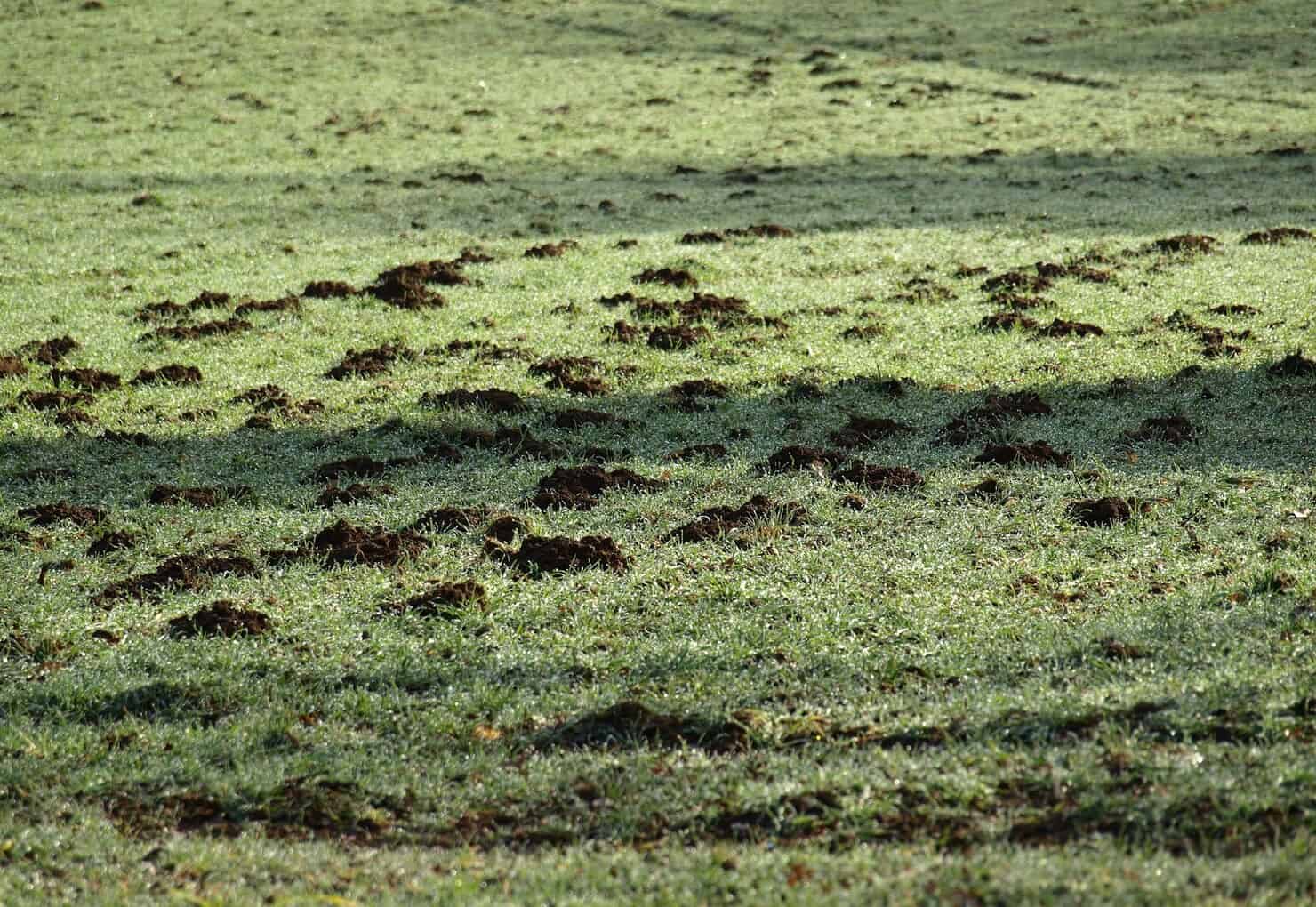
- Raised surface ridges running across the lawn in irregular patterns. These are feeding tunnels just below the grass surface. Press a section flat. If it raises again within 24 to 48 hours, the tunnel is active.
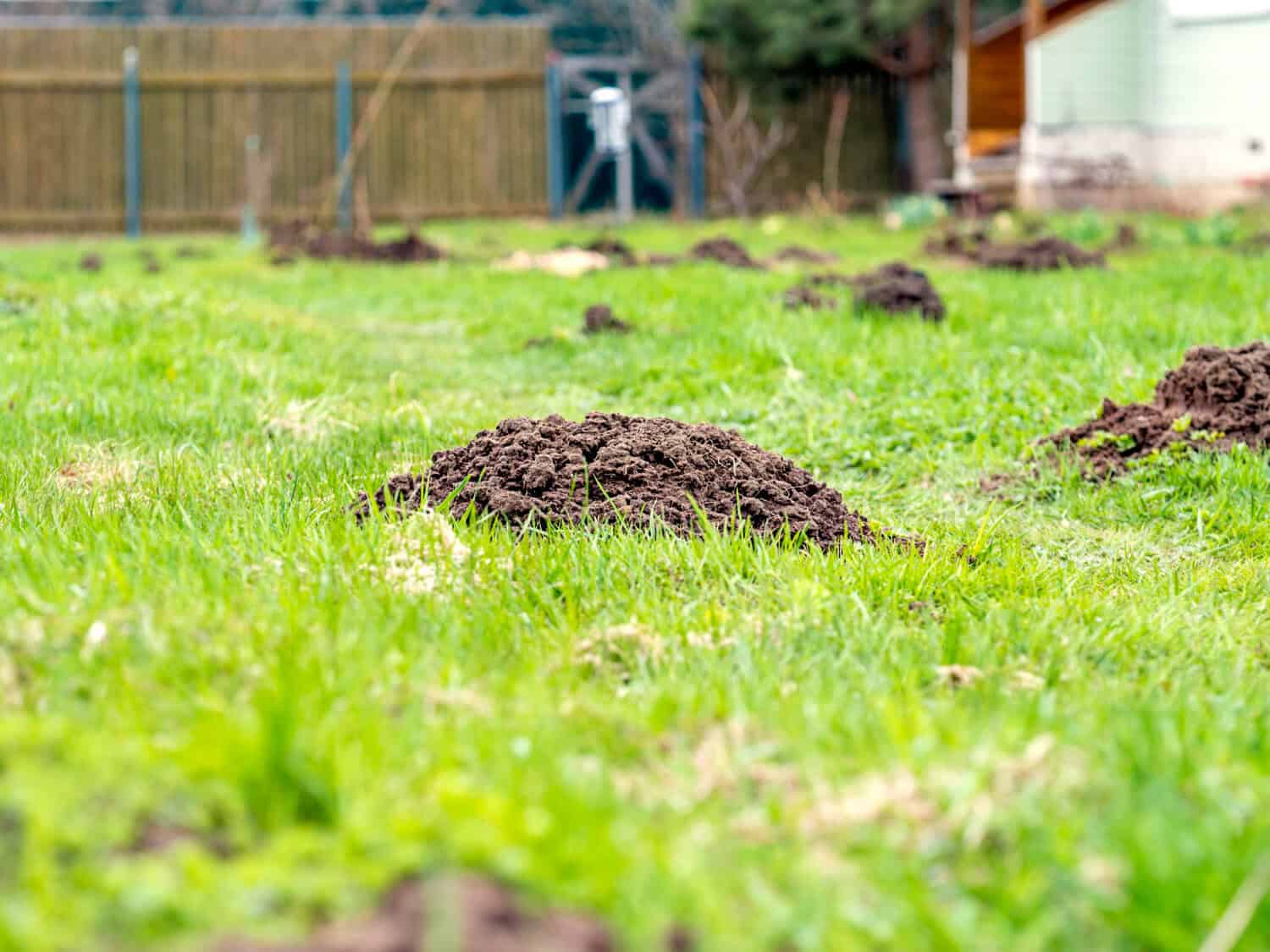
- Conical dirt mounds roughly the size of a large softball, with a circular shape and no visible entry hole at the top. These are excavation mounds from deeper tunnels.
- No visible holes in the lawn surface (an important distinction from vole holes).
- Damage that appears overnight, especially after rain.
- Spongy lawn when walked on, caused by undermined turf.
What it's probably NOT a mole
It's a vole if you see open holes about the size of a quarter or smaller
Voles create surface runways through grass and have visible entry holes. They are small rodents, not moles. They eat plants and bark, not earthworms, so mole traps will not catch them. Vole removal requires snap traps or bait stations placed at runway openings.
It's a chipmunk if you see a clean dime-sized hole at the base of a structure
Chipmunks dig single entry holes near foundations, retaining walls, woodpiles, or under steps. They are diurnal (active during the day) and visible. Mole trapping does nothing for chipmunks.
It's a groundhog if you see a hole 8 to 12 inches wide with a mound of dirt outside
Groundhogs (woodchucks) dig large burrows, usually with a primary entrance and one or more concealed exits. They are vegetarians and damage gardens and structures. Groundhog removal requires live cage trapping.
It's a shrew if you see very small mounds and find a tiny mouse-like body
Shrews are small insectivores that occasionally use mole tunnels. They're typically encountered as a body, not as live damage. Shrews are not the cause of significant lawn damage.
2. Why most "mole solutions" fail
The mole control market is full of products that don't work. Several have been studied. Most haven't. The ones that have been studied generally show poor results. Here's the honest breakdown.
Castor oil repellents
Castor oil is the most common active ingredient in over-the-counter mole repellents (Tomcat, MoleMax, similar brands). The theory: castor oil coats earthworms in the soil, makes them taste bad, and moles leave to find better food.
The reality is more mixed. Published field research and university extension studies on castor oil treatments show some short-term reduction in mole activity on small test plots, but the effect dissipates rapidly with rainfall and the moles return within weeks. Subsequent field experience suggests castor oil works occasionally, briefly, and rarely as advertised. Most homeowners apply, see activity slow temporarily, and then watch it return when fresh tunneling resumes.
Verdict: Weak evidence, short-lived, not a solution for an active infestation.
Ultrasonic spike devices
Solar-powered or battery stakes that vibrate or emit high-frequency sound. Marketing claims they drive moles away.
This category has been studied repeatedly. Peer-reviewed evaluations conducted through university wildlife programs have found no measurable difference in mole activity between yards using ultrasonic devices and untreated control yards. The Internet Center for Wildlife Damage Management has issued similar findings. The vibrations these devices produce dissipate within a few inches of the stake and do not affect mole behavior in any documented way.
Verdict: Does not work. The continued sale of these devices is one of the more enduring myths in lawn care retail.
Deterrent plants
Marigolds, daffodils, alliums, and "mole plant" (Euphorbia lathyris) are commonly recommended. The premise is that strong-scented plants drive moles away.
There is no controlled research demonstrating that any of these plants reduce mole activity in established lawns. Moles do not eat plants. They are deep-tunneling insectivores. Surface plantings have minimal interaction with mole feeding behavior. These plants are nice to have for other reasons but should not be considered mole control.
Verdict: No measurable effect on existing mole problems.
Poison gel baits (worm-shaped)
Brand names include Talpirid and similar. These are bromethalin-based gels shaped like earthworms, placed in active tunnels.
Unlike most mole solutions, these CAN work occasionally when placed correctly in heavily active tunnels. Effectiveness is inconsistent because moles often ignore baits in favor of live food, and successful placement requires identifying active tunnels (the same skill required for trapping). The serious downside: bromethalin is toxic to pets, wildlife, and children. Dead moles often remain in tunnels rather than emerging, attracting flies and other scavengers. Birds of prey, foxes, and outdoor cats can be poisoned through secondary exposure.
Verdict: Sometimes works but with safety risks that mechanical trapping avoids entirely.
Smoke bombs and gas cartridges
Lit cartridges placed in tunnels are meant to suffocate moles below ground.
Mole tunnel systems are extensive and well-ventilated. Smoke and gas dissipate rapidly through unsealed tunnel openings. Moles typically flee to unaffected sections of the network and return when the smoke clears. There's also a fire risk in dry conditions.
Verdict: Rarely effective. Not recommended.
Flooding tunnels with water
Some advice columns recommend running a garden hose into tunnels to drown moles.
This does not work in any soil type with reasonable drainage. Water simply flows through the tunnel network and into the surrounding soil. Moles relocate temporarily and return. The only result is a soggy lawn and an inflated water bill.
Verdict: Does not work. Also damages the lawn.
Grub control (eliminating the food source)
The common advice: kill the grubs, the moles will leave because they have nothing to eat.
This is partially correct but widely misunderstood. Grubs are a seasonal food source for moles, important in summer. Earthworms are the primary year-round food source, making up roughly 90% of an Eastern Ground Mole's diet. You cannot eliminate earthworms from healthy soil, and you would not want to (earthworms are essential to lawn health). Killing grubs may reduce mole activity slightly in late summer but will not solve a year-round mole problem.
Verdict: Partial effect at best. Doesn't address the actual primary food source.
3. The only method that works consistently: mechanical trapping
Mechanical trapping is the standard method recommended by university extension services (Penn State, Cornell, University of Missouri, Ohio State), wildlife management researchers, and professional removal specialists. It works because it targets the actual mole rather than trying to influence behavior or environment.
Types of mole traps
Scissor-jaw trap (most common professional choice)
A trap with two scissor blades that snap shut when triggered by a mole pushing through a tunnel. Reliable, easy to set, works on both surface tunnels and deeper runs. Examples: Out O' Sight, Victor Scissor-Jaw.
Harpoon trap (above-ground spike trap)
Spike trap that sits above the surface tunnel and drives spikes down when triggered. Effective on shallow surface tunnels. Examples: Victor Plunger-Style, similar.
Choker-loop trap
A spring-loaded loop that tightens when the mole pushes through a tunnel. Some professionals prefer this for clay soils.
What NOT to buy
- "Humane" live mole traps: Almost always fail because the mole, once captured, dies quickly from stress, dehydration, or starvation before you check the trap. They are not actually humane.
- "Universal" pest traps: Generic traps marketed for multiple species rarely work well for moles specifically.
- DIY pitfall traps: The "bury a coffee can in the tunnel" method occasionally works but is unreliable, time-consuming, and depends on luck.
4. Step-by-step trapping guide
Identify active tunnels
Walk the lawn and press down all visible surface ridges with your foot. Mark them with golf tees or flags. Wait 24 to 48 hours. The tunnels that re-raise are ACTIVE. The tunnels that stay flat are abandoned. Only trap active tunnels. This single step is where most failed DIY trappers go wrong.
Choose a straight section of active tunnel
Moles move faster and more predictably through straight runs. Avoid placing traps at intersections, curves, or near tunnel openings. A straight section of about 18 inches gives you the best chance of intercepting the mole.
Wear gloves and minimize disturbance
Moles have poor eyesight but excellent sense of smell and vibration. Human scent on the trap can cause them to plug the tunnel and reroute. Use gloves when handling traps and minimize soil disturbance around the placement site.
Open the tunnel and set the trap correctly
For scissor-jaw traps: cut a small opening across the tunnel, place the trap with jaws straddling the run, ensure the trigger plate sits in the path of mole movement. Follow your specific trap's instructions for trigger sensitivity. Cover the opening lightly to block light but not so heavily that you compress the tunnel.
Check the trap every 24 hours
If the trap has not triggered within 48 to 72 hours, the tunnel is likely not active or the placement is off. Move the trap to a different active tunnel. Do not leave unsuccessful traps in the same spot for a week. You'll waste days.
Continue trapping until activity stops for two weeks
A typical residential property has one to three moles, not the "infestation" most homeowners imagine. After catching one mole, monitor for new surface ridges. If new activity appears, repeat. If two weeks pass with no new activity, you've removed the problem (until the next migration).
5. Why moles come back, and what "permanent" actually means
The honest answer most articles avoid: there is no "permanent" mole removal in the absolute sense. Here's why.
Earthworm populations don't go away
Eastern Ground Moles (Scalopus aquaticus) and the other mole species across North America are obligate insectivores. Earthworms are their primary food source year-round. Earthworms are essential to soil health and are present in every well-maintained lawn. As long as you have soil, you have worms, and your property remains attractive to moles. Eliminating earthworms is neither possible nor desirable.
Moles migrate from surrounding properties
Removing the moles from your specific lawn does not stop new moles from migrating in from neighboring yards, parks, golf courses, woods, or farmland. A single mole's home range can span half an acre to several acres. If your neighbors are not trapping, you are receiving their migrating moles.
What "permanent" actually means in practice
Permanent results in mole control means:
- The current mole or moles are removed.
- New activity is detected and addressed quickly before damage compounds.
- The property is monitored, not just treated once.
For most homeowners, this is best achieved through one of two paths:
- Annual or semi-annual DIY trapping when new ridges appear, knowing you'll always need to be vigilant.
- Recurring professional monitoring service, where a specialist visits monthly or quarterly to catch new activity early.
The marketing claim of "permanent mole removal" is misleading regardless of the method behind it. What's actually being sold is ongoing management.
6. DIY vs. hiring a professional
Knowing how to get rid of moles in your yard is one thing. Knowing when to do it yourself versus when to call a specialist is another. Here's the honest breakdown.
When DIY makes sense
- You have one or two small affected areas, not a property-wide problem.
- You're willing to invest time in identifying active tunnels and learning trap placement.
- You've never tried (and failed) at trapping before, which means you have time to learn.
- Your yard is small enough to monitor easily, typically under quarter-acre.
- You can revisit traps daily for two to three weeks.
When a professional makes sense
- You've already tried DIY methods and the moles keep returning.
- You have a large property (half-acre or larger) with multiple affected zones.
- You have premium landscaping or irrigation infrastructure that you don't want to risk.
- You don't have time to inspect traps daily for weeks.
- You want recurring monitoring rather than reactive treatment.
- You're in an HOA or commercial property where damage is also an aesthetic and reputational issue.
What to look for in a mole removal specialist
- Mole removal specialty, not generic pest control. General pest control companies typically don't have field expertise in mole trapping specifically.
- Mechanical trapping methods only, not chemical applications.
- Better Business Bureau accreditation, ideally A+ rated.
- Verified customer reviews from real properties, not just star ratings.
- Fully insured for property work.
- Free property assessment before any service.
- Local knowledge of soil types, regional mole patterns, and seasonal activity in your specific area.
7. Safety considerations
Mechanical traps and children, pets
Mole traps have sharp mechanisms and significant trigger force. They should never be placed in areas accessible to children or pets. Mark trap locations clearly. Use trap covers when available. Check that pets cannot dig at trap locations.
Poison baits and secondary toxicity
If you choose to use bromethalin-based mole baits despite this guide's caution: dead moles can be eaten by outdoor cats, dogs, foxes, hawks, owls, or scavenger birds, all of which can suffer secondary poisoning. Poison baits are not recommended in households with pets or in properties near wildlife corridors.
Soil disturbance and existing infrastructure
Before digging or trapping near sprinkler systems, invisible dog fences, or buried utility lines, locate the infrastructure. Mole tunnels can run near or through these systems. Call 811 (the national underground utility locating service) before any significant digging.
Wildlife considerations
Moles are not endangered, but local laws on relocation, baiting, and trapping vary by state and county. Most states permit homeowner trapping without a permit. Some require permits for relocation. Check your state wildlife agency before relocating live-captured moles.
Frequently asked questions
How long does it take to get rid of moles?
DIY trapping of an established mole typically takes one to three weeks if you correctly identify active tunnels and place traps properly. Professional trapping services usually resolve a single-property mole problem within two to four weeks. If you're still seeing new activity after a month of consistent trapping, you're either trapping inactive tunnels or facing continuous migration from neighboring properties.
How many moles are usually in a yard?
Most homeowners overestimate. A typical residential property has one to three moles, not dozens. The extensive tunnel network is one mole's work over weeks or months. Eastern Ground Moles are solitary and territorial, with one adult per several acres in most cases. Heavy damage suggests one or two highly active moles, not a colony.
Does grub control get rid of moles?
Partially, and not reliably. Grubs are a seasonal food source. Earthworms are the primary year-round food source, making up about 90% of an Eastern Ground Mole's diet. Eliminating grubs may reduce summer activity but will not solve a mole problem that's driven by earthworm populations.
Do ultrasonic mole repellents actually work?
No. Multiple university extension studies have found no measurable effect on mole activity from ultrasonic spike devices. The vibrations dissipate within a few inches of the stake and do not influence mole behavior. The devices remain on the market because they generate consumer sales, not because they work.
What's the best time of year to trap moles?
Year-round trapping is effective. Moles do not hibernate. Spring (April-May) and fall (September-October) are peak activity seasons in most regions because wet soil drives earthworms to the surface. Winter trapping is often productive because tunnel patterns become predictable when surface soil freezes.
Will moles damage my house foundation?
No. Mole tunnels are typically 2 to 8 inches below the surface and do not affect house foundations or footings. Mole damage is cosmetic to the lawn and can damage irrigation lines, but is not a structural threat.
Are moles dangerous to children or pets?
No. Moles are solitary, defensive, and avoid contact with people and pets. They do not carry rabies. They do not bite unless handled directly. They are essentially invisible: most homeowners with active mole damage have never seen one in person.
Why do my neighbors not have moles when I do?
Usually one of three reasons: (1) their lawn has lower earthworm populations due to less consistent watering or different soil composition; (2) they have an active or recent trapping program; or (3) they have a slightly less attractive habitat that the current moles haven't migrated into yet. Moles do not respect property lines, and the next migration could be theirs.
Can I just live with the mole damage?
You can, with limits. Mole tunnels improve soil aeration and reduce certain insect populations. Some homeowners ignore minor activity. However, severe damage compounds: tunnels collapse the lawn, sever sprinkler lines, kill grass roots in heavily worked areas, and create tripping hazards. Light activity may be tolerable. Heavy activity affects property value, especially in HOA communities or premium suburbs.
Do mole traps kill the mole?
Standard scissor-jaw, harpoon, and choker-loop traps are lethal. "Humane" live mole traps almost always result in mole death from stress or starvation before they're checked, so the term "humane" is misleading. Mechanical lethal traps are quicker and more reliable.
What should I do with a dead mole?
Use gloves. Dispose in a sealed plastic bag in household trash, or bury at least 12 inches deep away from pet areas. Wash hands thoroughly. Moles do not commonly carry transmissible diseases but standard hygiene applies.
About Trap Your Moles™
This guide was developed by Trap Your Moles™, a mole removal specialist serving Greater Cincinnati, Dayton, Northern Kentucky, and Southeast Indiana. The company holds an A+ rating from the Better Business Bureau with 50+ verified customer reviews. Services are mechanical trapping only: no poisons, no chemicals, fully insured.
If you're located in the service area and want a free property assessment, call (513) 518-5639 or visit the contact page. If you're outside the service area, look for a local mole removal specialist with BBB accreditation and verified customer reviews, not generic pest control.
Need a professional assessment in Greater Cincinnati?
If you've tried DIY and the moles keep coming back, or your property is too large to monitor effectively, a free property assessment from Trap Your Moles™ can save you weeks of frustration. A+ BBB rated. Fully insured. No poisons.