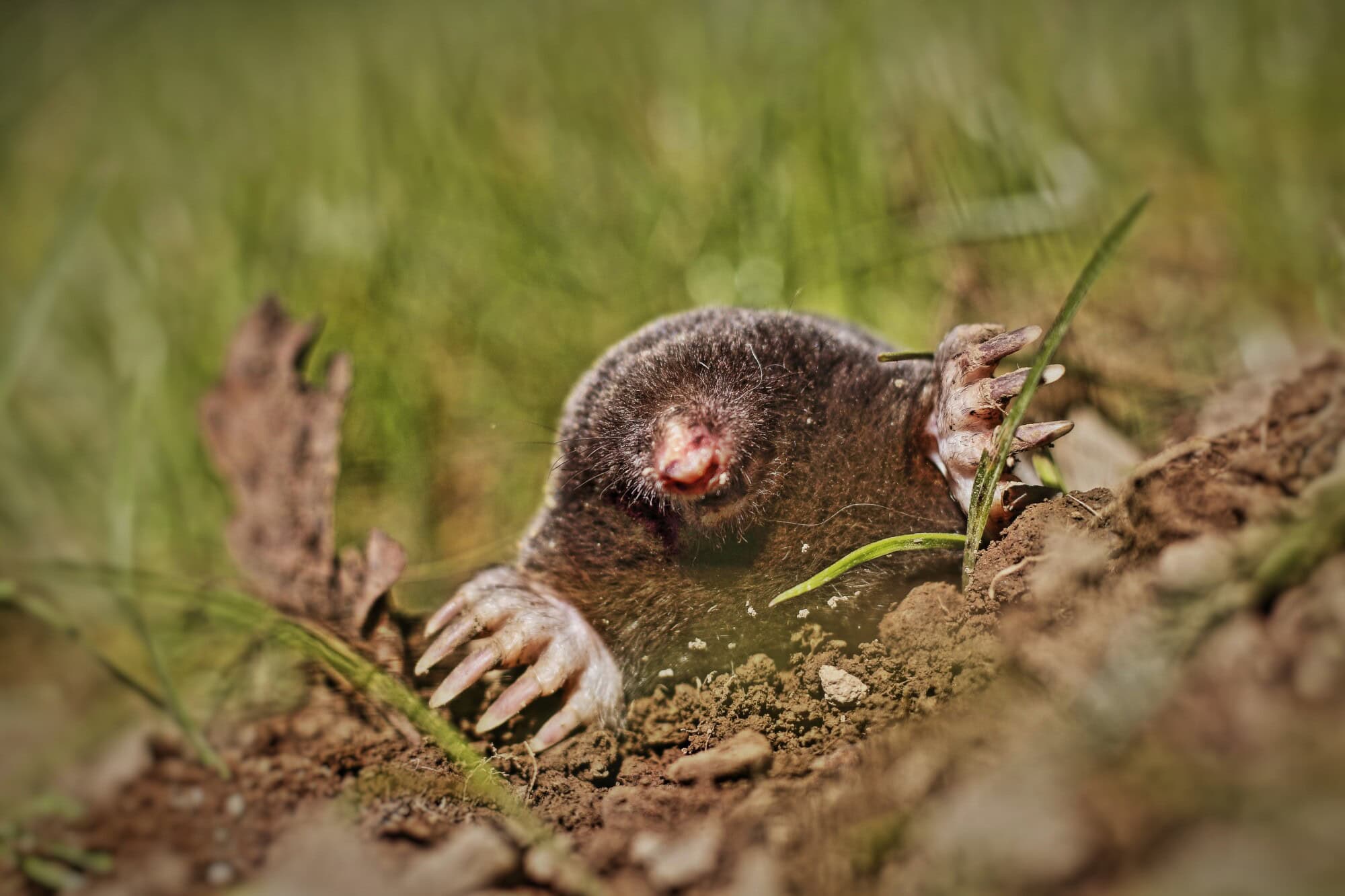
You can’t be too sure but you think there might be a mole in your house. You’ve been noticing molehills in your yard on a regular basis, and you’ve seen something scurrying around under your countertops over the last few days. You know you want to get rid of the little guy, but you’re also wondering: do moles carry diseases? Are moles dangerous to human beings?
Great question and one that we can answer in detail. Here’s everything you need to know.
Do Moles Carry Diseases?
Put simply, yes, moles do carry diseases. That said, not every mole is going to spread disease. Some are harmless, and some can do some serious damage.
For those that do carry disease, this is what they’re capable of spreading.
Rabies
Moles are not a meaningful rabies risk. In theory any mammal can carry rabies, a disease that attacks the nervous system, spreads through saliva (usually a bite) and is almost always fatal once symptoms start. In practice, rabies in moles is extremely rare, and a mole biting a person or a pet is rarer still. Moles spend nearly their whole lives underground and do everything they can to avoid contact.
If a mole ever does bite you or your pet, treat it like any wild animal bite: wash the wound well and call your doctor or your vet. That is the sensible precaution. It is not a reason to panic about the molehills in your yard.
Lyme Disease
The more realistic concern is what rides along on a mole. Moles can carry fleas and ticks in their fur, and ticks spread diseases you are far more likely to run into than rabies.
Perhaps the most prominent of these is Lyme Disease. This disease is carried by ticks, in particular, and an infected tick can pass it on if it stays attached long enough.
Some of the symptoms of Lyme Disease include rash, fever, nausea, joint pain, and general weakness. If not treated, Lyme Disease can cause death. It’s important to note, however, that the vast majority of Lyme cases are treated successfully with the use of antibiotics.
Anaplasmosis
Another disease caused by the ticks on moles is anaplasmosis. Like Lyme, this disease is spread through tick bites. Its symptoms are similar to Lyme’s symptoms as well, and they include chills, fever, muscle pain, and headaches.
In the most severe of cases, anaplasmosis can kill you (and animals like cats and dogs). Note, though, that early treatment of antibiotics will stave off the disease, allowing you to feel better within a few weeks of contraction.
Nonetheless, this isn’t a disease you want to get. It’s uncomfortable to go through and does pose a possibility of death.
Rocky Mountain Spotted Fever
Moles can also carry Rocky Mountain spotted fever, a tick-carried bacterial disease similar to anaplasmosis and Lyme Disease. This disease causes rash, fever, and headaches, and, in severe cases, can lead to death.
It’s important to note, however, that Rocky Mountain spotted fever can be completely treated with the use of antibiotics. The key is catching it early before the symptoms have taken over.
Again, this is not a disease that you want to compete against. Even if it doesn’t kill you, it will put tremendous stress on your body, subjecting you to an experience that you’ll wish you never encountered.
How Do Moles Get Into Homes?
Now, you might be curious: how did a mole get into your home in the first place? There are a number of different ways that a mole might have gotten in, including the following.
Through Foundation Cracks
Moles spend almost all of their time underground, digging tunnel systems to help them get from place to place. As such, if they’re entering your home, it’s almost certainly through a spot that you can’t see.
And what’s the one part of your home that’s underground? The foundation! So, if there’s a crack in that foundation, it wouldn’t be at all surprising for a mole to wiggle its way through it.
Through Basement Windows
Located just above the surface of the ground, basement windows can serve as another avenue through which moles can travel into a home. Whether that window’s damaged or opened just slightly, it could offer enough room for a mole to makes its way through.
As such, it’s generally best to keep basement windows shut. Not only do they serve as passageways for moles but for mice, rats, and a variety of other pests as well.
Through Siding
If your home’s siding is close to the ground, there’s a possibility that moles could make their way through it. All they need is a little gap and they’ll dig their way right in.
For this reason, you need to inspect your siding regularly and ensure that it’s covering the side of your home in its entirety. Make repairs as necessary to keep critters at bay.
Through Vegetated Areas
Moles are attracted to vegetated areas, as those are the areas where their prey – insects – tend to flock. Obviously, these areas won’t lead a mole into your home. However, if you have heavy vegetation around your house, moles are going to be hanging around it a lot more than they would otherwise.
Keep garden and flower beds away from the base of your home. And consider buffering your home with a plant-less bed of mulch
Need Help Ridding Your Home of a Mole?
And there it is, an answer to the question of “do moles carry diseases?” As you can see, moles are, indeed, quite capable of spreading disease, not only to humans but to dogs, cats, and other indoor pets as well. As such, if you have a mole in your home, you would be wise to get it out as soon as possible.
Need help ridding your home of a mole? If so and if you’re in the Cincinnati area, we here at TrapYourMoles.com have you covered.
Contact us now to discuss your problem!
Who to Call When Something Is Digging Up Your Yard
If you are in Greater Cincinnati, Dayton, Northern Kentucky or Southeast Indiana and the lawn is showing raised ridges, dirt mounds or fresh holes, call Trap Your Moles at (513) 518-5639. The line is answered 24 hours a day. A technician comes out, identifies the animal, and sets the right trap in the right spot. Mechanical and live trapping only, no poisons, free estimates.
- Mole removal for raised ridges and volcano-shaped mounds
- Vole removal for shallow surface runways and chewed plants
- Groundhog removal for one wide burrow hole by a shed or deck
- Chipmunk removal for clean two-inch holes along a foundation
- Not sure which one? The identification table on our services page walks through each animal, or just call and describe it.