Two kinds of calls come in after a week of hard spring rain. The first is from somebody who fished a mole out of the pool skimmer and cannot believe the thing was still paddling. The second is from somebody who ran a garden hose into the mole tunnels for an entire afternoon, watched the water disappear into the ground, and woke up to three brand new ridges across the front yard.
Both callers are running into the same fact. Moles swim, and they swim a lot better than an animal that lives in the dark underground has any business swimming. That one piece of biology explains why a mole survives the storms that soak Ohio Valley lawns every spring, why you sometimes find one somewhere wet and strange, and why flooding the tunnels is one of the most popular home remedies that never works. Here is what actually happens down there when the water comes in.
Key takeaways
- Moles can swim. Eastern moles paddle with the same broad front feet they dig with, and they cross puddles, ditches, and small creeks when they have to.
- Flooded tunnels rarely drown a mole. The tunnel network has several levels, water drains into the soil below, and the mole simply moves to a dry section or to higher ground until the water is gone.
- Running a garden hose into mole tunnels soaks your lawn and moves the mole for a day or two. It does not remove the animal, and wet soil pulls earthworms and moles back up toward the surface.
- A mole in a pool, window well, or basement stairwell is usually a young mole traveling above ground or an adult pushed out by heavy rain, not a sign the yard has more moles than before.
- Trapping in confirmed active runs is what removes a mole for good. Trap Your Moles guarantees mole removal across Greater Cincinnati with a free phone estimate at 513-518-5639.
Do Moles Swim?
Yes. Moles are capable swimmers. An eastern mole paddles with its wide, powerful front feet, keeps its snout above the surface, and can cross a flooded low spot, a drainage ditch, or a narrow creek. It does not choose to swim for fun, but when water forces the issue, it handles it well.
People are surprised by this because a mole looks like the least aquatic animal in the yard. No visible eyes, no ears you can see, a body shaped for pushing through dirt. It seems like it should sink.
It does not. Swimming mole videos turn up online every spring for a reason: when floodwater pushes a mole out of its burrow, it paddles off with a steady rhythm that looks a lot like the way it moves through loose soil. Anyone who has worked riverside property for long enough has seen it happen at least once.
The species that lives in almost every yard we trap is the eastern mole. There is also a mole in North America that is a true water animal, the star nosed mole, which dives and hunts underwater in wetlands mostly north and east of Greater Cincinnati. You are very unlikely to meet one in a Mason or Florence backyard. The mole tearing up your lawn is the eastern mole, and it swims out of necessity, not habit.
How Can an Animal Built for Digging Swim So Well?
Digging and swimming use the same motion. A mole moves through soil by sweeping its huge front feet out to the sides like a breaststroke, and it does the same thing in water. Its compact body, short dense fur, and partly webbed feet all help. Pushing water is easier than pushing clay.
Watch how a mole actually digs and the swimming makes sense. It does not claw straight down like a dog. The front feet sit turned outward on either side of the head, palms facing back, and the mole shoves soil to the sides in a powerful sweeping stroke while its back feet push it forward. That is essentially a breaststroke. In soil, every stroke moves heavy, packed earth. In water, the same stroke moves something far lighter.
The eastern mole’s scientific name is Scalopus aquaticus, and the second half of it comes from early naturalists who noticed the webbing on its toes and assumed it lived in water. It does not. But they were not completely off base. The feet really are broad paddles, and the body really is shaped to slip through a heavy medium with as little drag as possible.
The fur helps too. Mole fur is short, dense, and lies flat whichever way you stroke it, which lets the animal back up in a tunnel without its coat catching. We cover more about how the rest of the mole’s body is tuned for life underground, including its tiny covered eyes, in our post on whether moles are blind.
What Happens to Moles When the Yard Floods?
Usually, they move. Moles keep several tunnel levels, and water drains through the soil into the lower runs and away. As a low spot fills, the mole retreats to a drier section or pushes new tunnels toward higher ground. When the water drains, it returns, often digging harder than before because wet soil brings earthworms up.
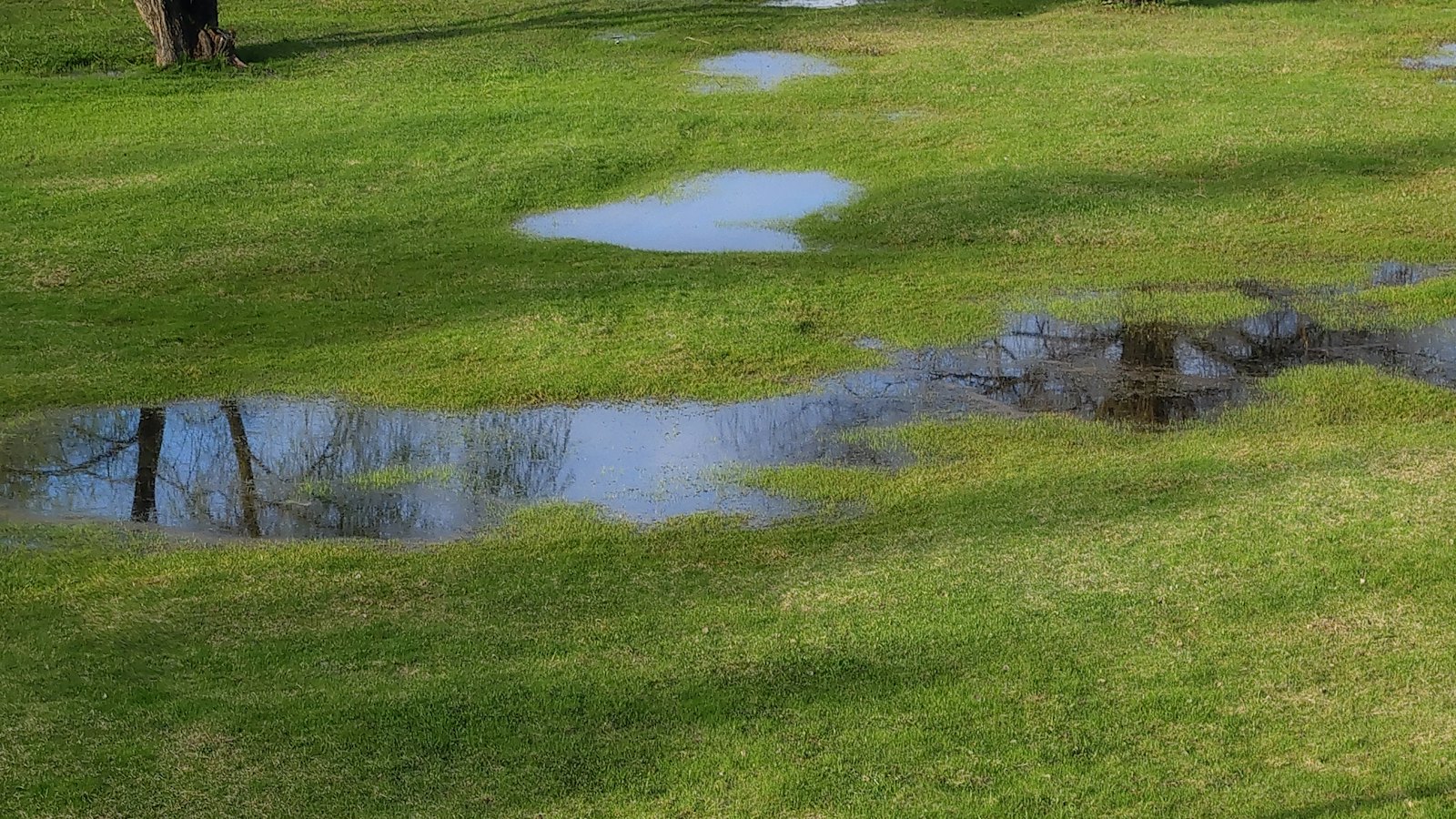
Greater Cincinnati is a hard place to be a lawn in April. Much of the region sits on heavy clay that holds water, and a lot of the nicest yards are in river valleys along the Ohio, the Little Miami, and the Great Miami. After a week of storms it is common to see standing water in the low half of a yard for days. Homeowners reasonably assume that has to be bad news for whatever is living under it.
It is mostly an inconvenience for the mole. A mole’s tunnel system is not a single straight pipe. It has shallow feeding runs just under the grass, deeper travel tunnels, and nest chambers that are usually placed under something solid and often on the higher, better drained part of the property. We explain how that layout works in our post on how deep moles dig. When water moves in, the mole has somewhere to go, and it goes there.
What happens after the water drains is the part homeowners notice. Soaked soil is soft and easy to dig, and earthworms move up toward the surface in wet ground. The mole follows the worms. So a very wet spring week is often followed by a burst of fresh ridges, which makes it look like the rain brought moles in. It did not. It brought the mole you already had up to where you can see it working. That same rhythm shows up in our write up on when moles are most active.
Low lying yards in river towns like Lawrenceburg and Newport see a real version of this after big river rises. A long flood can push moles off bottomland entirely, and some drown or get picked off by hawks while they are exposed on the surface. The ones that survive tend to resettle on the higher ground nearby, which is often somebody’s lawn.
Does Flooding Mole Tunnels With a Garden Hose Work?
No. A hose cannot fill a tunnel system that runs hundreds of feet through several soil levels, and the water drains into the ground faster than you can add it. The mole moves to a dry section, waits, and comes back. Meanwhile you have soaked the lawn, and wet soil pulls earthworms and moles toward the surface.
This is one of the home remedies we hear about most, and it is easy to see why it is tempting. You find a hole, you have a hose, and water going into a tunnel feels like it should accomplish something. For about an hour it even looks promising, because the water keeps going in and nothing comes back out.
That disappearing water is the problem. Think about the scale. One mole can keep a tunnel network that runs across most of a typical suburban lot, with feeding runs near the grass and travel tunnels much deeper. The water you pour in runs down to the lowest point and soaks into the soil around it. It never fills the system, and it never reaches the parts of the network sitting uphill from the spot where you put the hose.
Here is what the mole does while that is going on. It feels the water, moves to a section of tunnel that is dry, and waits. Moles live in sealed tunnels with stale, low oxygen air as a matter of course, so sitting still in a pocket of the network for an afternoon is nothing unusual for them. By the next morning the ground is soft, the worms have come up, and the mole is back to pushing fresh ridges through the most saturated part of your yard.
There are real costs, too. Running a hose for hours near the house can put water against a foundation and into a basement, and it can wash out soil around the tunnels so that sections of lawn sink later. And if you have heard that you should flood the tunnels to push the mole out so you can catch it with a shovel, understand that you can stand over a flooded run for a very long time without seeing anything. The mole already has a dozen other ways to go.
Flooding belongs with castor oil and chewing gum on the list of remedies that feel like action without removing anything. We tested the gum idea in our post on whether Juicy Fruit gum kills moles, and we cover the rest of the category in why DIY mole removal does not work.
Can You Drown a Mole in Its Tunnels?
Not in a normal yard with a normal amount of water. Drowning a mole would take filling its entire tunnel network faster than the soil can drain it, with every escape route cut off. A hose or a sump pump discharge line cannot do that. The mole moves ahead of the water and survives.
We get this question in a lot of forms. Pour a bucket in the mound. Run the sump pump discharge into the tunnels. Dig a trench and flood it. Every version has the same weakness. The mole is not trapped in the spot you are flooding. It is living in a large network with many exits, and it moves faster than the water fills anything.
Moles do die in real floods, the kind that put a whole river bottom under water for days with no high ground in reach. That is a very different situation from a garden hose in a subdivision, and it is not something a homeowner can recreate on purpose. If the goal is a yard without a mole in it, the water plan loses every time.
Why Do I Find Moles in the Pool, Window Well, or Stairwell?
Because moles sometimes travel above ground, and those spots are traps they cannot climb out of. Young moles leaving their birth tunnels in late spring cross open ground to find a territory, and heavy rain can push adults up too. A mole that falls into a pool can swim, but it cannot get over the edge.
A mole on the surface is out of its element. It cannot see much, it moves slowly, and it tends to follow edges. That leads it straight into pools, window wells, basement stairwells, and the gaps along a patio or driveway. Swimming pools are the classic case. The mole paddles around the edge looking for a way out, and eventually ends up in the skimmer basket, which is where most people find it.
If you find one, wear gloves. Moles are not aggressive, but a scared animal will bite, and those teeth are made for crushing insects. Most of the moles found this way are young ones passing through, and the one in the pool is not necessarily the one that is building ridges in your lawn.
What a mole in the pool does tell you is that moles are moving through your neighborhood. If you are also seeing raised runs and fresh mounds, that is the animal to focus on, and it is not going to wander into a skimmer on its own schedule.
What Actually Gets Rid of Moles After a Wet Spell?
Trapping the mole in runs it is actively using. The busy digging that follows heavy rain makes active runs easy to find and confirm, which is good timing for trapping. Trap Your Moles guarantees mole removal across Greater Cincinnati, Northern Kentucky, and Southeast Indiana, with a free phone estimate and no sales visit needed.
The wet stretch that makes a lawn look its worst is actually a good time to trap. Moles are working near the surface, fresh ridges are obvious, and a flattened section of run that gets pushed back up within a day tells a trapper exactly which corridors the animal is using. A trap set there, at the right depth, takes the mole out of the system for good. It does not matter whether the ground is wet or dry, whether the mole can swim, or how many afternoons somebody spent with the hose.
That is the core of trapping moles the way we do it: read the yard, confirm activity, remove the animal, and check that the runs stay flat. Our mole removal service is built on that process. We are A plus rated with the BBB, we work lawns from Cincinnati through Northern Kentucky and Southeast Indiana all season, and we guarantee the result.
If the rain has brought a fresh wave of ridges across your yard, call 513-518-5639 and tell us what you are seeing. You will get a free phone estimate with no sales visit needed, or you can reach us here.
Common Questions
Can you put water down a mole hole to get rid of the mole?
You can, but it will not remove the mole. The water drains into the soil and lower tunnels long before it fills the network, and the mole moves to a dry section until the water is gone. Wet soil also brings earthworms up, so the digging often gets worse over the next few days.
Do moles drown when it rains?
Rarely. Rain soaks into the soil and drains through the lower tunnels, and a mole simply moves to a drier part of its network or to higher ground. Only long, deep flooding with no high ground nearby, like a river bottom under water for days, tends to kill moles.
Can moles swim underwater?
The eastern mole found in Greater Cincinnati yards swims at the surface and is not a diver. The star nosed mole, a wetland species found mostly north and east of here, does dive and hunt underwater. For the mole in your lawn, swimming is a way to escape water, not a way to feed.
Do moles like wet soil?
Moist soil, yes. It is easy to dig and full of earthworms, their main food, so moles are most active near the surface after rain. Standing water is different. Moles move away from saturated low spots and return once the water drains and the soil is soft and damp again.
Will a flooded yard make moles leave for good?
Almost never. A mole pushed out by standing water usually waits in a drier part of its tunnels or on nearby higher ground, then comes back once the yard drains. The territory, the tunnels, and the earthworms are all still there, so the mole has every reason to return.
Photo by Yura Stroganov on Unsplash