The call always has the same shape. A squirrel got into the garage, or the kids were feeding one on the back patio, or somebody reached into an attic soffit and felt teeth. Then everyone goes quiet for a second and somebody says the word rabies.
Here is the answer before anything else, because it is the one people need: squirrels are one of the lowest rabies risk animals in North America. Not zero in theory. Close enough to zero in practice that public health agencies treat a squirrel bite very differently from a bat or a raccoon bite. That does not make a squirrel bite nothing. It just means the thing most people are frightened of is not the thing worth worrying about.
Key takeaways
- Small rodents like squirrels, chipmunks, mice and rats are almost never found with rabies, and the CDC notes they have not been known to pass rabies to a person in the United States.
- The animals that actually carry rabies in our part of Ohio and Kentucky are bats, raccoons, skunks and foxes. A bat in the house is the one that gets a same day phone call.
- Squirrels do bite, and nearly every bite happens for one reason: a person had a hand near a squirrel. Hand feeding, grabbing a baby, or reaching blind into an attic void.
- The real medical issue with a squirrel bite is wound infection and your tetanus status, not rabies. Wash it hard, then call your doctor the same day.
- Trapping is mechanical, with no poisons and no chemicals, so the yard and the attic stay safe for kids and pets while the work gets done.
Do Squirrels Carry Rabies?
Almost never. Squirrels are small rodents, and small rodents are very rarely found infected with rabies. The CDC says rodents like squirrels, chipmunks, rats and mice have not been known to transmit rabies to people in the United States, so a squirrel bite almost never leads to rabies shots.
Rabies is a virus that lives in the saliva of an infected mammal and moves by a bite. Any mammal can catch it in theory, and that theoretical line is where most of the internet panic comes from. People read “any mammal” and stop reading.
What the data on rabies actually shows is that the virus circulates in a short list of wildlife species, and squirrels are not on it. There is a practical reason for that, and it is worth understanding because it is more reassuring than any number.
A rabid animal has to survive a bite from another rabid animal long enough to incubate the virus and then pass it on. A raccoon that tangles with a rabid skunk usually walks away. A gray squirrel that gets bitten by a rabid raccoon usually does not walk away from anything. The attack that would infect it is the attack that kills it. So the virus has no path through the squirrel population, and it never establishes itself there the way it has in bats and raccoons.
That is why your doctor will almost certainly not start rabies shots over a squirrel. It is also why we can tell a homeowner on the phone, honestly, that the squirrel in their attic is a property problem and not a health emergency.
Why Are Squirrels Such a Low Rabies Risk?
Because small rodents rarely survive an encounter with a rabid predator, the virus never gets a foothold in squirrel populations. Rabies needs a host that lives long enough after infection to bite something else. Squirrels fill the prey role, not the carrier role, so they stay outside the chain.
There is one rodent exception worth naming, because it lives here too. Woodchucks, which everyone around Cincinnati calls groundhogs, account for most of the rodent rabies cases that do get reported, and they turn up mainly in the mid Atlantic states where raccoon rabies has been established for decades. A groundhog is big enough and tough enough to live through a fight with a rabid raccoon, which is exactly the thing a gray squirrel cannot do.
That is a real difference in how we treat the two jobs. A groundhog acting strangely in daylight gets handled with more caution than a squirrel doing the same thing, and groundhog removal is a different animal from a squirrel in a soffit in more ways than size. It is not a reason to be afraid of groundhogs either. It is a reason to let somebody with traps and gloves do it instead of a shovel and good intentions.
The other thing people get wrong is assuming a squirrel that acts odd is rabid. Far more often it is something else entirely, and we get into that further down.
Which Animals Actually Carry Rabies Around Cincinnati?
Bats first, then raccoons, skunks and foxes. Bats are the species behind most human rabies cases in the United States, and a bat found in a bedroom is treated as an exposure even without an obvious bite. Those are the calls that go to a doctor and the health department the same day.
We work yards and attics across Greater Cincinnati, Dayton, Northern Kentucky and Southeast Indiana, and the wildlife list in this region is the same one the health departments watch. Bats, raccoons, skunks and foxes are the animals where rabies is a genuine consideration. Squirrels, chipmunks, voles, moles, rabbits and mice are not.
That matters for a homeowner in a very practical way, because what you have in the attic changes what you do next. Scratching in a wall at dawn and dusk with a lot of daytime activity is usually a squirrel. Heavy thumping after dark, a smell, and damage that looks like something with hands did it is usually a raccoon, and raccoon removal is the right call for that one. If you wake up and there is a bat in the room, that is not a trapping question at all, that is a phone call to your doctor.
Telling those apart from the floor below is harder than it sounds, which is why our first visit is usually spent in the attic with a flashlight rather than setting anything. The droppings alone will often answer it, and we wrote up what squirrel droppings look like for exactly that reason.
Do Squirrels Bite?
Yes, but almost always defensively. A squirrel bites when it has been cornered, picked up, or hand fed by someone whose fingers got confused with the peanut. Squirrels do not chase people or attack unprovoked. The bite is quick, it draws blood, and then the animal is gone.
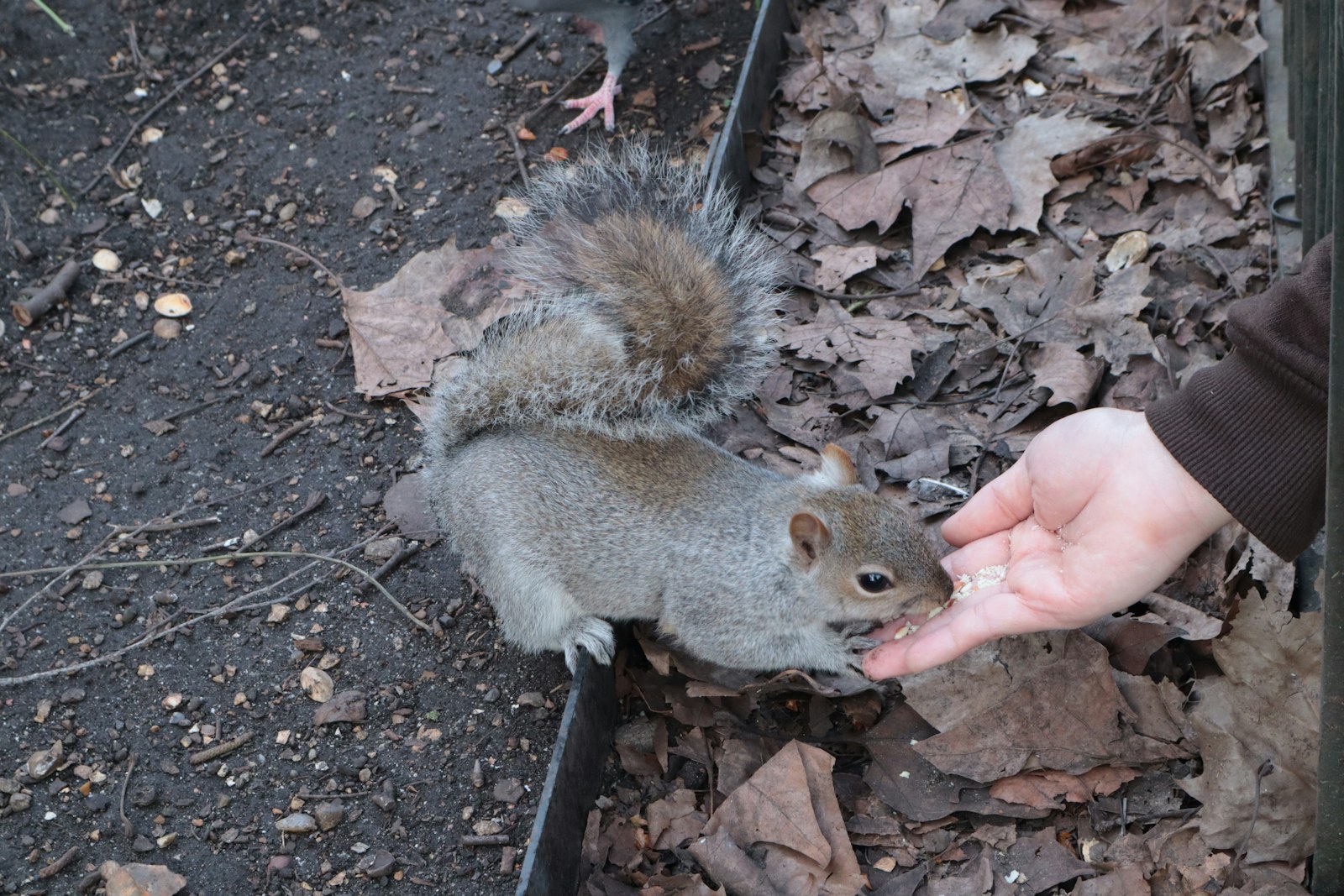
Look at the photo at the top of this page again. That is the bite waiting to happen, and it is the single most common way people in this region get bitten by a squirrel. A hand fed squirrel has learned that fingers mean food. It is working fast, it has poor close range eyesight for something that small in a palm, and sooner or later it takes a finger instead of the seed.
The second most common way is a baby squirrel. Every spring and again in late summer we get calls from people who found a young one on the ground and picked it up. A juvenile squirrel is still a wild animal with full sized incisors, and a frightened one in a cupped hand will use them.
The third is reaching blind. Somebody puts a hand into a soffit gap, an attic eave, a chimney chase, or the back of a cluttered garage shelf without looking, and finds a squirrel that has nowhere left to go. That one is entirely avoidable and it is the one that worries us most on a job site, because the homeowner has usually already tried it before we arrive.
A squirrel has four large chisel shaped front teeth that grow continuously and are built to open black walnuts. They go through fingers easily, and they go through wiring insulation, roof sheathing and soffit trim just as easily, which is the other half of why we get called. If you want the longer version of that damage story, we covered it in why squirrels keep coming back to an attic.
Worth noting that this is a different animal from the one most of our calls are about. If you landed here off a different question, the mole version of the same question is a very different answer.
What Should You Do After a Squirrel Bite or Scratch?
Wash the wound with soap and running water for several minutes, then call your doctor the same day. Rabies shots are almost never recommended for a squirrel bite, but infection is a real risk and your tetanus status matters. For a pet, the same call goes to your vet.
We are trappers and not doctors, so the only responsible advice here is to make the call rather than read about it. What we can tell you is what the call is usually about, because homeowners ask us afterward.
It is usually about bacteria. A rodent mouth is not clean, the teeth are narrow and they drive bacteria deep into a puncture rather than laying it open, and punctures are the wound type most likely to get infected. It is usually about tetanus, because most adults are further past their last booster than they think. And it is sometimes about whether the wound needs to stay open rather than be closed up.
What it is almost never about is rabies. Your doctor or the county health department will make that call, not a web page, and they make it based on the animal and the circumstances. For a squirrel the answer is usually no. Do not let that stop you from calling.
Keep the same standard for your dog. A dog that corners a squirrel under a deck and gets bitten on the muzzle is a vet call that day, and so is a dog that caught and mouthed one.
What Does a Sick Squirrel Look Like, if Not Rabies?
Usually mange, injury or poisoning. A squirrel with patchy bald skin has mange mites. One that is wobbling or circling has most likely taken a hit from a car or eaten rodent bait somebody else put out. A young one approaching people is normally orphaned and hungry, not sick.
This is the part people most want and almost never find, because every page they land on is about rabies and nothing else.
Mange is the big one and it looks alarming. A squirrel loses fur in patches, the skin goes grey and crusted, and in winter the animal looks skeletal. It is a mite, it is miserable for the animal, and it is not rabies and not a danger to you from across a yard.
A squirrel that is circling, dragging a back end, tilting its head or falling off things has usually been hit by a car or has gotten into poison bait. We see the poison version more than we would like, which is one of several reasons we do not use or recommend bait of any kind. It does not solve the problem and it produces exactly this.
A young squirrel that walks up to you and will not leave is almost always an orphan looking for food. It is not acting rabid, it is acting hungry. The right move is to leave it alone and call a licensed wildlife rehabilitator rather than pick it up, which is the exact decision that ends in a bite.
The honest summary: in years of pulling these animals out of attics and walls around Cincinnati, the odd behaving squirrels we meet are sick, hurt or hungry. That is what the odds say and that is what we find.
How Do You Get a Squirrel Out Without Anyone Getting Bitten?
Nobody puts a hand near the animal. The job is finding every entry point, trapping or excluding the squirrels already inside, then sealing the holes so the next one cannot follow. Trapping is mechanical with no poisons and no chemicals, so the attic stays safe for kids and pets.
The sequence matters more than the equipment. Sealing a roofline before the animals are out traps them inside, and a squirrel shut in a soffit will chew its way to daylight through whatever is softest, which is usually your trim or your drywall. Get them out first, then close it.
Our squirrel removal work runs in that order. We walk the roofline and find the gaps, which are usually at the gable vents, the soffit returns, the fascia board joints and wherever a roof plane dies into a wall. We handle the animals that are already inside. Then we close the openings so the next squirrel in the neighborhood, and there is always a next one, cannot use the same door. Signs that a yard or attic has reached the trapping stage are usually obvious once somebody points them out.
Timing is part of it too. Squirrels around here have two litter seasons, late winter into spring and again in late summer, and an attic job during either one is slower and needs more care. Knowing how long a squirrel actually lives tells you something useful about why the same roofline keeps getting hit year after year. If it is already inside a wall cavity rather than the open attic, the approach changes again, and we wrote that one up under getting a squirrel out of a wall.
We are licensed and insured, we work across Cincinnati, Dayton and Northern Kentucky, and the Kentucky side of the work is done in line with Kentucky wildlife regulations. Satisfaction guaranteed.
If something is in the attic and you would rather not be the one reaching into it, call 513-518-5639 for a free phone estimate. No sales visit needed, and we will tell you on the phone whether it sounds like a squirrel or something that needs a different conversation. Our office is open Monday to Friday, 8 AM to 6 PM Eastern, or you can send us the details here.
Common Questions
Do squirrels carry rabies?
Almost never. Squirrels are small rodents, and small rodents like squirrels, chipmunks, rats and mice are very rarely found infected with rabies. The CDC notes they have not been known to transmit rabies to a person in the United States. A squirrel bite still needs washing and a same day call to your doctor, but rabies shots are almost never part of that conversation.
Can you get rabies from a squirrel bite?
It is close enough to zero that public health guidance treats squirrel bites very differently from bat or raccoon bites. The real risks from a squirrel bite are wound infection and your tetanus status. Wash the wound with soap and running water for several minutes and call your doctor the same day. Let them decide, not a web page.
Do squirrels bite people?
Yes, but defensively rather than aggressively. Squirrels do not chase or attack people. Nearly every bite we hear about comes from hand feeding, from somebody picking up a baby squirrel, or from reaching blind into a soffit, chimney chase or cluttered garage shelf. Stop hand feeding them and the risk mostly disappears.
What animals carry rabies in Ohio and Kentucky?
Bats first, then raccoons, skunks and foxes. Bats are behind most human rabies cases in the United States, and a bat found in a bedroom is treated as a possible exposure even with no visible bite. Squirrels, chipmunks, mice, rabbits, voles and moles are not meaningful rabies carriers here.
Why is a squirrel in my yard acting strange?
Usually mange, injury or poisoning rather than rabies. Patchy bald grey skin is mange mites. Wobbling, circling or head tilting is normally a car strike or rodent bait somebody put out nearby. A young squirrel that approaches people is almost always orphaned and hungry. Leave it alone and call a licensed wildlife rehabilitator instead of picking it up.
Photo by Kirsten C. on Unsplash