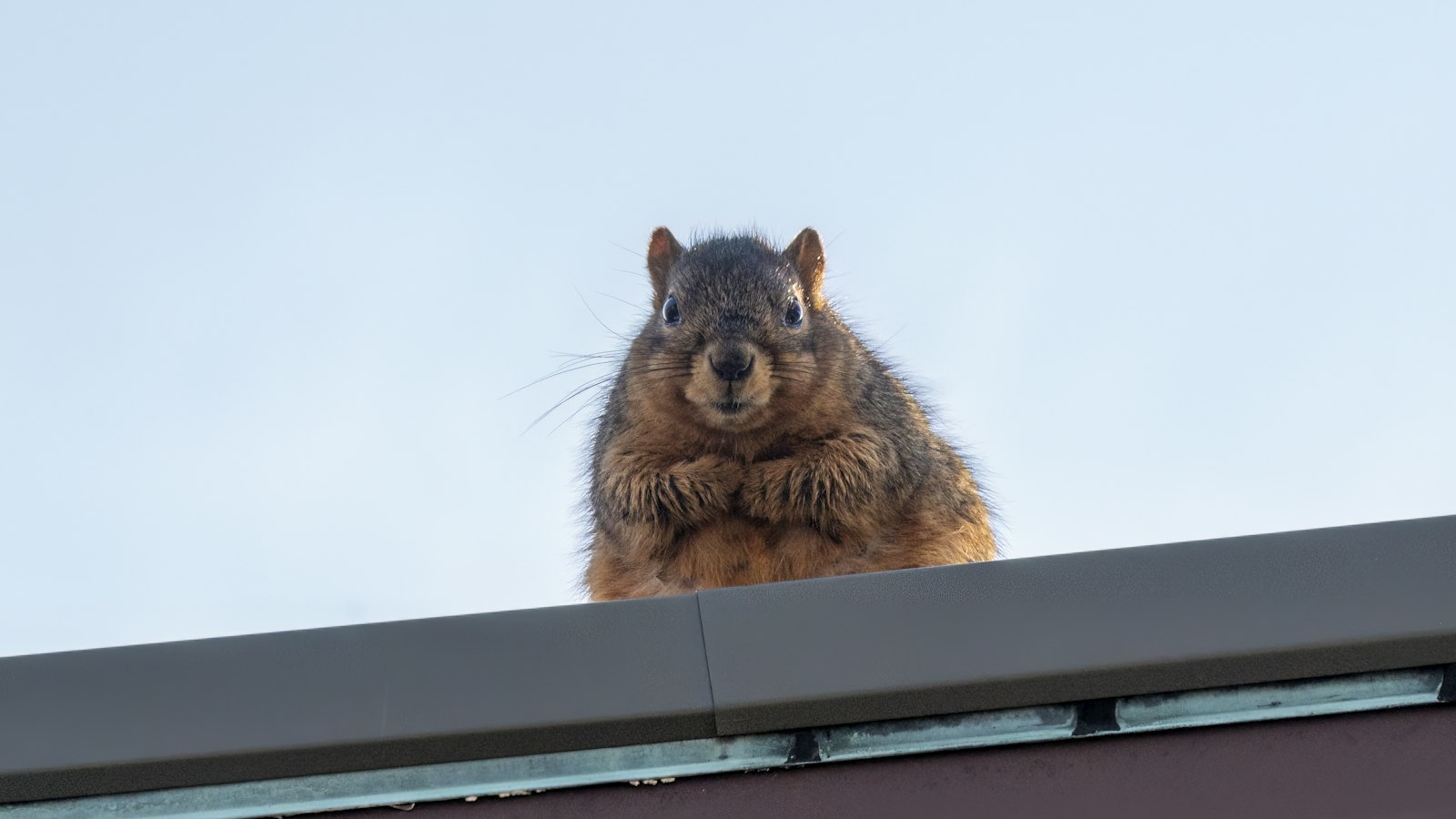
The call usually comes in the middle of the morning, and the person on the other end is standing in a hallway with their hand flat against the drywall. There is something in there. They can hear it scratching about chest height, in one spot, and it has been going on for three days. The question is always the same two parts. What is it, and how do I get it out without tearing my house apart.
In this part of Ohio and Kentucky it is usually a squirrel, and the good news is that the wall is almost never where it meant to be. A squirrel in a stud bay made a wrong turn on its way somewhere else, and that changes how you handle it. Here is what is happening behind that drywall, why the instinct to seal the hole makes it worse, and what gets the animal out without a hole in your wall.
Key takeaways
- Scratching inside a wall during daylight hours is the signature of a squirrel. Mice and rats are mostly a night sound, and a raccoon is heavier and slower. Squirrels are active in the day, hardest in the first hours after sunrise and again late afternoon.
- A squirrel almost never enters a wall directly. It gets into the attic or the soffit through a roofline gap, then drops down an open stud bay and cannot climb back up the smooth sheathing.
- The real damage risk is chewing. Squirrel incisors never stop growing, so the animal gnaws constantly, and in a wall cavity the things to gnaw are framing, insulation and whatever wiring runs through that bay.
- Do not seal the entry hole first. That is the single most common mistake, and it either traps the animal inside your wall or sends a separated mother chewing through new material to get back to her litter.
- Late winter and late summer are the two litter seasons, and fall is when squirrels go shopping for a warm place to overwinter, so Greater Cincinnati gets a wave of these calls from September through the first hard cold.
- Trapping and exclusion are mechanical. No poisons and no chemicals go into the house, so the work is safe around kids and pets.
- Trap Your Moles is licensed and insured and handles squirrels across Greater Cincinnati, Dayton, Northern Kentucky and Southeast Indiana. Free estimate by phone at 513-518-5639, no sales visit needed.
Is That a Squirrel in My Wall or Something Else?
Listen to the clock before anything else. Squirrels are active in daylight, so scratching and scrabbling you hear mid morning or late afternoon is almost certainly a squirrel. Mice and rats move mostly after dark, raccoons are heavy and slow and usually overhead, and a mole cannot get into a wall at all.
Time of day does more diagnostic work here than any other clue, and most people already have the answer without realizing it. If the noise wakes you at two in the morning and stops around dawn, you are dealing with a nocturnal animal and you should be thinking mice or rats. If you hear it while you are making coffee, and then again around four in the afternoon, that is a squirrel keeping squirrel hours.
The second clue is the quality of the sound. A squirrel in a stud bay is loud and frantic in bursts. Thirty seconds of hard scratching and scrabbling, sometimes a thump as the animal falls, then nothing for twenty minutes, then it goes again. Mice are a steady, light rustle with a lot of small tapping. A raccoon you do not have to strain to hear, slow heavy movement with real weight behind it, and it is normally in the ceiling rather than a wall, because an adult raccoon does not fit in a standard stud bay.
The third clue is where. A wall cavity between studs is a narrow vertical shaft, so the sound stays in one place or travels up and down rather than across the room. If what you are hearing moves horizontally over your head, that is the attic floor, and our piece on squirrels in the attic is the one you want.
Two things to rule out while we are here. It is not a mole: moles cannot climb anything, which we went through in can moles climb, so there is no route from the yard into a wall cavity for them. A chipmunk is the one genuine mixup, since they are also active in daylight, though they turn up at the bottom of a wall near the foundation far more often than up at chest height. We cover that in chipmunk in the house.
How Does a Squirrel Get Into a Wall?
Almost never through the wall itself. A squirrel gets onto the roof, finds a gap at the soffit, fascia, gable vent or a dormer junction, and enters the attic or the soffit void. From there it drops down an open stud bay at the top plate and ends up inside the wall, usually by accident.
This is the part that surprises homeowners, and it matters because it tells you where to look. Nobody chews a hole through siding into a stud bay. The entry is up high, on the roofline, and it is often somewhere you cannot see from the ground.
A squirrel gets to the roof the easy way. An overhanging limb is the classic route, and we have a lot of mature oaks and maples sitting right over rooflines around here, but a squirrel does not need a tree. It will go straight up brick, up a downspout, up a corner board.
Once it is up there it works the edges, and the places that fail are predictable: the joint where the soffit meets the fascia, a gable vent with a torn screen, the valley where a dormer roof meets a wall, a lifted corner of aluminum fascia wrap, and anywhere a previous repair was done with the wrong material. Squirrels also make their own door. A rotted fascia board is soft and one will open it up in an afternoon.
Here is the part that gets it into your wall. In a lot of houses the top of the wall cavity is open to the attic or the soffit void, because the framing was never meant to be a sealed box. There is a gap between the studs where the wall meets the roof structure, with insulation sitting on top of it rather than filling it. A squirrel moving through the attic puts a foot wrong, slips into that gap and goes down the bay. Now it is standing on a fire block or the bottom plate, in a shaft maybe fourteen inches wide, smooth sheathing on one side and smooth drywall on the other.
It cannot climb that. A squirrel is superb on bark, brick and anything with texture, but it needs something to sink a claw into, and the back of drywall gives it nothing. In a narrow bay it often cannot even turn around and point itself upward. That is why the scratching is so frantic and so fixed in one place.
Worth knowing in older Cincinnati and Northern Kentucky housing stock: balloon framed houses, much of what went up before the 1930s here, have stud bays running uninterrupted from basement to attic with no fire blocking. In one of those, an animal that gets in at the roofline can end up two floors down.
What Does a Squirrel in a Wall Sound Like?
Hard, dry scratching in short bursts, often with a thump or a scrabble as the animal falls back down the cavity. It is louder and more urgent than a mouse and it comes from one fixed spot rather than traveling. Expect it concentrated in the early morning and again in the late afternoon.
People describe it to me as claws on cardboard, which is about right. Drywall from the back side is paper, and a squirrel working at it makes a dry raking sound that carries surprisingly far through a quiet house. The bursts are the giveaway: a hard effort to climb, a slide back down, a rest, another go.
If there is a litter in the wall rather than a single adult, the sound changes. Young squirrels make a thin, high chirping and a kind of mewing that people often mistake for birds. If you hear that, call somebody before you do anything else. That situation is more complicated than one trapped animal and the wrong move makes it considerably worse.
There is also a sound people hope for and should not count on, which is the sound stopping. A wall going quiet does not reliably mean the animal left. It can mean it is resting, and it can mean something worse, which is the next section but one.
A useful thing to do while you wait: tap the wall where you hear it and listen for a response, then work along tapping to find the edges of it. A squirrel will usually react. That narrows it to a specific bay, and having that ready saves real time, because working out which cavity we are dealing with is the first thing we do anyway.
Is a Squirrel in the Wall Dangerous?
The animal is not going to come through the drywall at you, but the chewing is a genuine problem. Squirrel incisors grow continuously and the animal gnaws constantly to manage them, so anything in that bay gets chewed, including electrical wiring. That is the risk worth taking seriously.
Let me be straight about the scare factor, because a lot of nonsense gets written about this. A squirrel inside a wall is not going to break into your living room. It is a frightened animal in a confined space and it wants out, not in.
The chewing is the real issue. A squirrel’s front teeth grow for its entire life, which is why it gnaws the way it does. It is not malice and it is not hunger, it is maintenance. Put that animal in a closed stud bay and the things available to work on are the framing, the insulation, the back of the drywall and any cable running through the bay. Wire runs through stud bays everywhere in a house. That is what a stud bay is for.
Beyond chewing there is nesting material if the animal has been in a while, urine and droppings soaking into insulation and sometimes into drywall, and the smell that comes with it. None of that is an emergency on day one, and all of it gets worse the longer it goes.
On health, use ordinary sense. It is a wild animal and it will bite if you corner it, which is the main reason not to catch one by hand. Keep children and pets away, and do not handle droppings or soiled insulation without gloves and a mask. If you are seeing signs in more than one place, the fuller picture is in our signs you need squirrel trapping services.
Should I Seal the Hole to Keep It Out?
Not yet, and this is the mistake that causes most of the bad outcomes. Sealing first either locks the animal inside your wall with no way out, or separates a mother from a litter, and a separated mother will chew through fresh material and sometimes through drywall to get back to her young.
This is the most important paragraph on this page, so I will put it plainly. Every homeowner who finds the hole wants to close it, and closing it is the right thing to do, just not first and not yet.
There are two ways it goes wrong. The first is obvious once you see it. If the animal is inside when you seal, you have not solved the problem, you have sealed the problem into your wall. Now it dies in there, and we will get to what that means.
The second is the one nobody anticipates. From late winter into spring and again in late summer, a squirrel in your structure is very often a female with a litter. She goes out to feed, you find the hole while she is gone and close it up, and she comes back to a wall between her and her young. She is not going to shrug and leave. She will work at the new material, look for another way in, and often create a second entry somewhere worse. People end up with more damage after sealing than they had before.
That is also why we do not touch poison, for squirrels or anything else. It does not solve a structural problem, it puts a dying animal inside your walls, and it creates a hazard for pets and for whatever else eats the carcass.
The correct order is: get the animals out first, confirm the structure is empty, then seal every opening with material an animal cannot chew through. Sealing is the last step, not the first.
What Happens if a Squirrel Dies Inside the Wall?
You will know within a few days. A dead animal in a wall produces a strong, sweet, unmistakable smell that gets worse for a week or two before it fades, and it usually brings flies. The carcass has to come out, which normally means opening the drywall at the right spot and repairing it after.
This is the outcome we are trying to avoid, and it is why the sealing advice above is as blunt as it is. A squirrel that cannot get out of a stud bay, or that gets closed in by a well meaning repair, will not survive long without water.
The smell comes first, usually three or four days in and faster in a warm month. It is distinctive enough that people recognize it immediately. Flies follow, and that is often what finally tells somebody there is a carcass rather than a live animal, because you start finding blowflies at a window in a room you do not use.
No trick makes this go away on its own. Masking does not work and the odor will not clear while the source is in there. The carcass has to be located and removed, and because the cavity is closed that usually means a small deliberate opening cut in the least damaging spot. Done right it is a modest patch job. Done by guessing you end up with several holes and the smell still there, which we get called in to finish more often than you would think. Existing customers can read how we handle that on our trapped animal removal page.
The reason to act in the first week, while the animal is alive and still making noise, is that live removal is a far smaller job than dead removal. Noise is information. Silence is not good news.
How Do You Get a Squirrel Out of a Wall?
Find every entry point first, work out whether there is a litter, then remove the animals and close the structure. Depending on where the squirrel is sitting, that means one way exclusion at the roofline, trapping, or on a genuinely stuck animal a small controlled opening. Sealing comes last, with chew proof material.
A real job starts outside and on the roof, not at the wall where you hear the noise. We walk the full roofline and look at every place that commonly fails, because the hole you can hear is rarely the whole story and a house that let one animal in usually has a second weak spot.
Then we work out whether there are young. The season tells us a lot before anybody gets on a ladder, and so does the sound. A litter changes the timing and the method, and the specifics depend on what the inspection turns up and on the wildlife regulations in the state the house sits in. On the Kentucky side of the river we hold the license to trap squirrels, and that work is done in line with Kentucky wildlife regulations.
For an animal moving freely between the attic and the outside, exclusion does most of the work. A one way door over the main entry lets the squirrel out and will not let it back in, and the rest of the openings get closed while that is in place. For animals that will not move to the door, or where the layout does not suit one, we trap. Either way it is mechanical, no poisons and no chemicals, and it is safe to have going on around kids and pets.
The genuinely stuck squirrel is its own case, and sometimes you can simply give it a route. A heavy rope or a length of welded wire dropped down the cavity from above gives the animal something to grip, and plenty of them will take it and climb straight out. That is worth trying first because it costs nothing but time. When it will not work, the answer is a small opening cut in the right place, the animal removed and the wall patched. One clean cut in a chosen spot beats five exploratory holes.
Then the structure gets closed properly, with material a squirrel cannot chew through at every opening, not foam and not a sheet of aluminum tacked over a rotted board, because the animal that found the first gap will test the repair. Our squirrel removal work runs those three stages in order, and the sealing is what decides whether you see us again. The same roofline gaps bring in the other climbers, which is why a raccoon removal call and a squirrel call so often turn up the same failed soffit.
The part a homeowner can genuinely do is the diagnosis: listen at different times of day, find which bay it is, look for the hole at the roofline with binoculars from the ground. What goes wrong is the ladder work, the sealing sequence and handling the animal.
What It Looks Like When We Handle It
Somebody comes out, walks the roofline and the attic, and tells you what you have and where it got in. If there is an animal in a cavity, getting it out comes first. We also tell you plainly if there is soiled insulation or chewed wiring somebody else needs to look at.
We cover the whole tri state, including Cincinnati and Dayton and the Northern Kentucky and Southeast Indiana suburbs in between. We are licensed and insured, and satisfaction guaranteed means what it sounds like. We do what it takes to get it right.
If you are hearing something right now, call and describe it: what time of day, how loud, whether it moves or stays put, whether anything sounds like young. That is usually enough for us to tell you over the phone what you have before anybody comes out. The number is 513-518-5639, the office is open Monday through Friday from 8 AM to 6 PM, and the estimate costs nothing. You can also reach us through the contact page.
Common Questions
How do I know if it is a squirrel in my wall and not a rat?
Time of day separates them better than anything else. Squirrels are active in daylight, so noise in the morning and late afternoon points to a squirrel, while rats and mice are mostly a night sound that quiets down around dawn. The texture differs too. A squirrel makes hard scratching in bursts with thumps as it slides back down the cavity, and a rodent makes a lighter, steadier, more continuous rustle. A squirrel is also much louder than people expect from an animal that size.
Will a squirrel in the wall leave on its own?
Sometimes, if it can reach the way it came in. The problem is that a squirrel that has dropped into a stud bay usually cannot climb back out, because the inside faces of drywall and sheathing give it nothing to grip and the bay is too narrow to turn around in. An animal moving freely between an attic and the roofline may well come and go on its own, but one you can hear scratching in the same spot for days is stuck and will not free itself.
Should I seal the hole where the squirrel got in?
Not before the animals are out. Sealing first either traps the squirrel inside the wall, where it will die and create an odor and carcass removal problem, or it separates a mother from a litter. A separated mother will chew through fresh repair material and often opens a second entry somewhere worse, so people frequently end up with more damage after sealing than before. Get the structure empty first, confirm it, then close every opening with material a squirrel cannot chew.
Can a squirrel chew through a wall into my house?
It is uncommon but it does happen, usually when the animal is desperate or when a mother is trying to reach young on the other side. Drywall is soft from the back and a determined squirrel can open it. That is one reason not to leave a trapped animal in a cavity for weeks hoping it resolves itself. The more routine damage is chewing on framing, insulation and any wiring that runs through that stud bay, which is the risk worth acting on.
What time of year do squirrels get into walls?
Two patterns drive it. Squirrels have litters roughly in late winter and again in late summer, so those are the periods when a female is looking for a sheltered place to raise young. Then in fall, from about September until the first hard cold, healthy adults go looking for somewhere warm to spend the winter. That autumn push is when Greater Cincinnati, Dayton and Northern Kentucky homeowners make most of these calls, because that is when squirrels start testing rooflines in earnest.
How much does it cost to get a squirrel out of a wall?
It depends on where the animal is, how many entry points the house has and whether there is a litter, so a number quoted sight unseen would be made up. Call 513-518-5639 and describe what you are hearing and roughly where. We give free estimates by phone, no sales visit needed, and we can usually tell you from the description what you are dealing with and what the work involves before anyone comes out.
Photo by Cathy Holewinski on Unsplash