Most people find it with a flashlight. They are up in the attic in November looking for the box of Christmas decorations, the beam swings across the insulation, and there is a scatter of dark pellets on top of a joist. Or it is on the garage floor along the back wall, or on a shelf above the lawnmower. The phone call that follows is almost always the same question asked two ways. What left this, and does it mean something is living in my house.
Droppings are the most reliable piece of evidence a homeowner finds on their own, better than noise and much better than a glimpse out the window, because they tell you where the animal actually spends its time. The trouble is that a pellet is a pellet to most eyes, and squirrel, rat and mouse droppings get mixed up constantly. So here is how to read them, what the location tells you, and how to handle the cleanup without making it worse.
Key takeaways
- Squirrel droppings are roughly 3/8 of an inch long and about 1/8 of an inch across, barrel shaped with rounded or blunt ends, dark brown and slightly glossy when fresh, fading to a dull tan or grey as they dry out.
- Rat droppings are the main thing they get confused with, and size settles it. A Norway rat leaves a pellet closer to 1/2 to 3/4 of an inch, and a mouse leaves one about 1/8 to 1/4 of an inch with pointed ends rather than rounded.
- Where you find them matters as much as what they look like. Squirrels leave droppings concentrated where they den and feed, often on a joist or in the insulation, while mice and rats trail theirs along the routes they run.
- Do not sweep or vacuum dry droppings. Disturbing them raises dust, and the practical risk in a den is bacteria in the urine and droppings plus the fleas, ticks and mites the animal leaves behind.
- Droppings on a deck rail or fence post with no entry damage on the roofline usually mean a squirrel is using the outside of your house. Droppings inside an attic, wall or garage mean something is denning in the structure, and that needs removal plus sealing, not cleanup alone.
What Does Squirrel Poop Look Like?
Squirrel droppings are small barrel shaped pellets about 3/8 of an inch long and 1/8 of an inch across, with rounded blunt ends rather than points. Fresh ones are dark brown and faintly glossy. As they dry they lighten toward tan or grey and get brittle. You usually find several together, not one.
Picture a coffee bean that has been stretched a little and you are close. The ends are the detail worth fixing in your head, because they are rounded off instead of tapering to a point, and that single feature separates a squirrel from a mouse faster than anything else.
Freshness reads clearly once you know what to look for. A dropping left in the last day or two is dark and has a slight sheen to it, and it will still be soft if something presses on it. After a week in a dry attic it has gone matte, pale and hard, and it crumbles. That matters more than people expect. If you find a pile that is uniformly chalky and grey with nothing fresh in it, you may be looking at an old den from a previous season rather than an active problem. If dark pellets are sitting on top of pale ones, something is using that spot right now.
The other thing to notice is quantity. Squirrels produce a lot. A single animal denning in an attic for a few weeks leaves far more than most people picture, and a female with a litter leaves more still. One or two pellets on a windowsill is a visitor. Dozens worked into the insulation is a resident.
How Do You Tell Squirrel Poop From Rat Poop?
Size is the fastest test. Squirrel droppings run about 3/8 of an inch with rounded ends. Norway rat droppings are noticeably bigger, roughly 1/2 to 3/4 of an inch, and often capsule shaped. Mouse droppings are smaller, about 1/8 to 1/4 of an inch, and taper to a point at the ends.
Lay the three side by side and nobody confuses them. Found one at a time in a dim attic, people get it wrong all the time, and they usually get it wrong in the same direction: they assume rats. Rat is the word that comes to mind when anybody finds a pellet indoors, and it is the wrong word most of the time in a Cincinnati or Northern Kentucky attic.
A few things that help when the size call is borderline:
- Shape of the ends. Rounded and blunt points to a squirrel. Pointed or tapered points to a mouse. A rat dropping tends to look like a blunt capsule and is simply too large to be a squirrel.
- Where it sits. Mice and rats are ground travellers. They run baseboards, pipe runs and the edges of a space, and their droppings follow those lines. A squirrel comes in from above and works from a den, so its droppings cluster in one area rather than trailing.
- What else is in the picture. Chewed wiring, shredded insulation pulled into a heap, a gnawed hole in a fascia board or a soffit corner, and noise in the daytime all point to squirrel. Gnawed food packaging, grease marks along a wall and strictly night noise point to rodents.
- Time of day you hear it. This is the single best companion clue. Squirrels are active in daylight, hardest in the first hours after sunrise and again in late afternoon. Mice and rats are mostly a night sound.
One honest limit here. We do not send droppings to a lab, and no trapper in this area does. What we actually do is read the droppings next to the entry damage, the sound and the season, and that combination is reliable. A dropping on its own is a strong clue, not a verdict.
Where Do You Find Squirrel Droppings in a House?
Attics are the most common place, usually on top of joists, in the insulation near a gable vent or along the ridge. Garages, sheds and open soffit cavities come next. Droppings also turn up on outdoor surfaces a squirrel travels, like deck rails, fence tops, window ledges and porch beams.
In an attic, the location tells you the shape of the problem. Droppings concentrated in one corner near a vent usually mean the den is right there and the animal is going in and out through that opening. Droppings spread through the insulation over a wide area generally mean the animal has been in there a while, or there is more than one.
There is a detail worth checking before you call anybody. Look at whether the droppings are sitting on top of the insulation or down in it. On top means recent. Worked down into the fibre, with the insulation matted and flattened in a bowl shape, means a nest has been there long enough to compress it, and there is a decent chance of soiled insulation that somebody will need to look at after the animals are out.
Garages catch people by surprise. A garage with a gap at the top of the overhead door track, or an open gable vent, is as attractive as an attic and gets checked far less often. If you are finding droppings on a shelf or along the back wall of a garage, look up at the junction where the wall framing meets the roof, not at the floor.
Older housing stock across Greater Cincinnati and Northern Kentucky gives squirrels more of these openings than newer construction does. Wood soffit and fascia that has weathered, box gutters, roof returns, and uncapped chimneys all give an animal something to work on. That is why we walk the whole roofline on an inspection instead of looking only where the noise is.
Is Squirrel Poop Dangerous?
Treat it as a real but manageable hazard. Squirrel droppings and urine can carry bacteria such as salmonella and leptospira, and dried droppings raise dust when they are swept or vacuumed. The more common practical problem is the fleas, ticks and mites a den leaves behind in your insulation.
Use ordinary sense rather than alarm. Do not handle droppings with bare hands, do not let children or pets near a contaminated area, and above all do not sweep or vacuum dry droppings. Sweeping is the single worst thing people do, because it puts dried material into the air of a space that connects to the rest of the house.
Two things we get asked often enough to answer here. Squirrels are not a notable rabies risk. Small rodents like squirrels, chipmunks and mice are almost never found to be infected with rabies, and public health guidance reflects that. And squirrel droppings are not the bird and bat droppings problem people have read about, which is a different organism entirely. The honest answer about squirrels is that the bacteria and the parasites are the real items, and both are handled by not disturbing the material dry and by getting the den cleaned properly.
The parasite side is the one homeowners underrate. An animal that has been nesting in insulation for weeks leaves fleas, ticks and mites in that insulation, and those do not leave with the squirrel. People sometimes report a flea problem starting a week or two after an animal was removed, and that is the reason. It is also why cleanup is part of the job rather than an afterthought.
Do Droppings Mean a Squirrel Is Living in My House?
Not always. Droppings on an outdoor surface such as a deck rail, fence top or window ledge usually mean a squirrel travels there, which is normal and needs nothing. Droppings inside an attic, wall, garage or soffit mean something is denning in the structure, and that does need addressing.
This is the part where we talk ourselves out of work, and it is worth saying plainly. If you find a handful of droppings on a railing or a porch beam, walk the roofline and the soffit line and look for chewed openings, torn screening on a vent, or a gap where two roof planes meet. If there is no entry damage and no daytime noise overhead, you have a squirrel that sits on your deck. That is a yard animal. There is nothing to trap and nothing to pay for.
Inside is different, and there the question is not whether to act but how quickly. The clock matters because of chewing. Squirrel incisors never stop growing, so the animal gnaws constantly, and what is available to gnaw in an attic is framing, ductwork and wiring. Chewed wiring in an attic is a fire risk, and that is the reason we tell people not to sit on an active attic squirrel through a winter, and why professional squirrel removal pairs trapping with sealing rather than doing one or the other.
Season shapes the answer too. Litters come roughly in late winter and again in late summer, so a female may be in there with young, and that changes the order of operations completely. Fall into early winter, which is right now across Ohio and Kentucky, is when healthy adults go shopping for somewhere warm. That autumn push is when most of these calls come in.
Should I Clean Up the Droppings Myself?
You can clean a small amount on a hard outdoor surface safely. Wet it down first, wear gloves, bag it and wash up afterward. Do not dry sweep or vacuum droppings in an attic, and do not clean an attic den while an animal is still using it. Removal comes first, cleanup second.
The order is what people get backwards. Cleaning an attic while a squirrel is still coming and going means doing it again, and it also means working in a confined space with an animal that will bite if it feels cornered. Get the structure empty, confirm it is empty, close the openings, then deal with what is left behind.
For the small outdoor cases, the method is simple. Spray the area with a household disinfectant and let it sit so nothing goes airborne, wear disposable gloves, pick it up with a paper towel rather than a broom, bag it and tie the bag, then wash your hands. That is enough for a few pellets on a rail.
Inside an attic the scale is different and so is the risk. Matted, soiled insulation needs removing rather than cleaning, and that is a job with the right protective equipment, not a shop vac on a Saturday. If you are looking at a contaminated area larger than a dinner plate, that is the line where it stops being a homeowner job.
What Does the Removal Actually Involve?
An inspection of the whole roofline and attic to find every opening, then removal with one way doors and live cage traps, then sealing each entry point with material a squirrel cannot chew. Cleanup and soiled insulation come after the structure is confirmed empty. No poisons are used at any stage.
Somebody comes out, walks the roofline, the soffits, the vents and the attic, and tells you what you have and where it got in. Finding every opening is the part that decides whether the job holds, because an open gap is the reason most attic squirrels come straight back after somebody chases them out.
Removal is mechanical. One way doors let the animal leave and not return, and live cage traps handle the rest. No poisons and no chemicals go into the house, which is why this work is safe around kids and pets. In Northern Kentucky we hold the Kentucky license for squirrel work, so trapping there is done in line with Kentucky wildlife regulations.
Then the openings get closed with material that does not yield to teeth, and we tell you plainly if there is soiled insulation or chewed wiring that somebody needs to look at. We are licensed and insured, and satisfaction guaranteed means what it sounds like. We do what it takes to get it right.
If you have found droppings and want to know what you are dealing with, call and describe them: roughly how long, whether the ends are rounded or pointed, where they are, and whether anything sounds like it is moving overhead in the daytime. That is usually enough for us to tell you over the phone. We cover Cincinnati, Dayton and Northern Kentucky, the number is 513-518-5639, the office is open Monday through Friday from 8 AM to 6 PM, and the estimate costs nothing. You can also reach us through the contact page.
Already caught something in a trap of your own? Do not open it. See trapped animal removal and call.
Related reading: squirrels in the attic and why they keep coming back, how to get a squirrel out of a wall, the signs you need squirrel trapping services, and if the droppings are tiny and the holes are at ground level, how chipmunks get into a house. Full detail on the service itself is on our squirrel removal page.
Common Questions
What size are squirrel droppings?
About 3/8 of an inch long and roughly 1/8 of an inch across, which puts them between mouse and rat droppings in size. The ends are rounded or blunt rather than pointed. Fresh pellets are dark brown with a slight sheen and are still soft, and after several days in a dry attic they turn pale tan or grey, go hard and crumble easily. You almost always find a group of them rather than a single pellet.
Are squirrel droppings bigger than rat droppings?
No, smaller. A Norway rat leaves a pellet roughly 1/2 to 3/4 of an inch long, which is noticeably larger than a squirrel's 3/8 of an inch, and a rat dropping often looks like a blunt capsule. Mouse droppings are the smallest of the three at about 1/8 to 1/4 of an inch and they taper to a point. If a pellet is clearly bigger than a grain of rice but smaller than a raisin, with rounded ends, squirrel is the likeliest answer.
Is squirrel poop dangerous to humans?
It should be handled carefully but it is not cause for panic. Squirrel droppings and urine can carry bacteria such as salmonella and leptospira, and dried droppings release dust when they are swept or vacuumed, which is the main reason not to dry clean them. In practice the problem we see most often is the fleas, ticks and mites left behind in insulation after an animal has been denning there. Wear gloves, wet the area before cleaning, never dry sweep, and keep children and pets away from a contaminated space.
Do squirrels carry rabies?
Very rarely. Small rodents like squirrels, chipmunks, mice and rats are almost never found to be infected with rabies, and public health guidance reflects that. That said, any wild animal will bite if it is cornered or handled, and a bite should always be looked at by a doctor. The health items actually worth planning around with squirrels are the bacteria in a den and the parasites left behind in insulation, not rabies.
Where do squirrels poop in an attic?
Usually in concentrated areas rather than spread evenly, because they go where they den and feed. Look on top of the joists, in the insulation near a gable vent or along the ridge, and on any flat surface like a stored box or a piece of plywood decking. Droppings sitting on top of the insulation point to recent activity, while droppings worked down into matted, flattened insulation suggest a nest has been in place for a while.
Do droppings on my deck mean squirrels are in my house?
Usually not. Droppings on a deck rail, fence top, window ledge or porch beam normally mean a squirrel travels across that surface, which is ordinary behaviour and needs nothing done about it. What matters is whether there is a way in. Walk the roofline and soffit line and look for chewed openings, torn vent screening or a gap where two roof planes meet, and listen for movement overhead during the day. No entry damage and no daytime noise means you have a yard squirrel, not a resident.
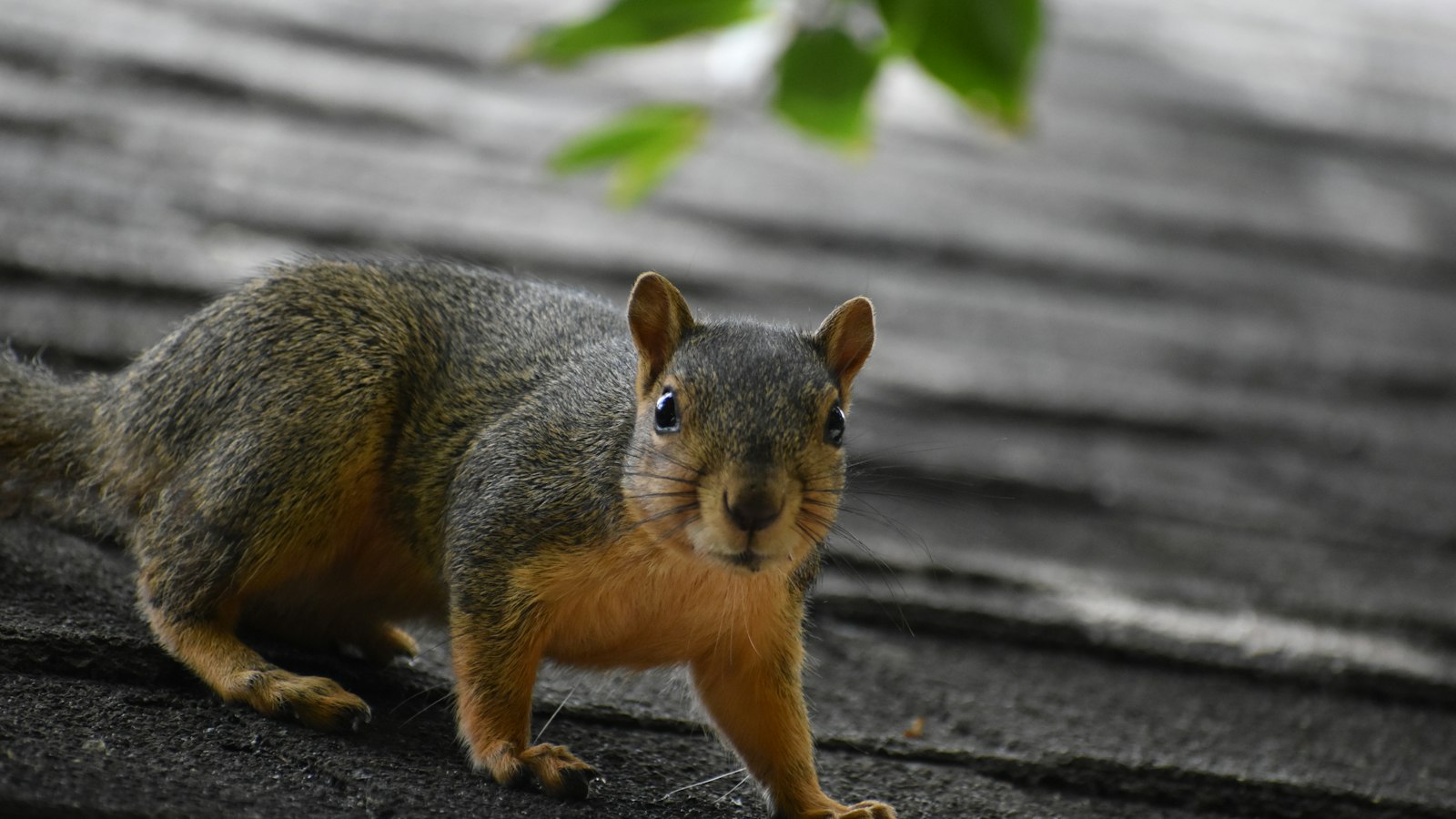
Photo by Hayleigh B on Unsplash