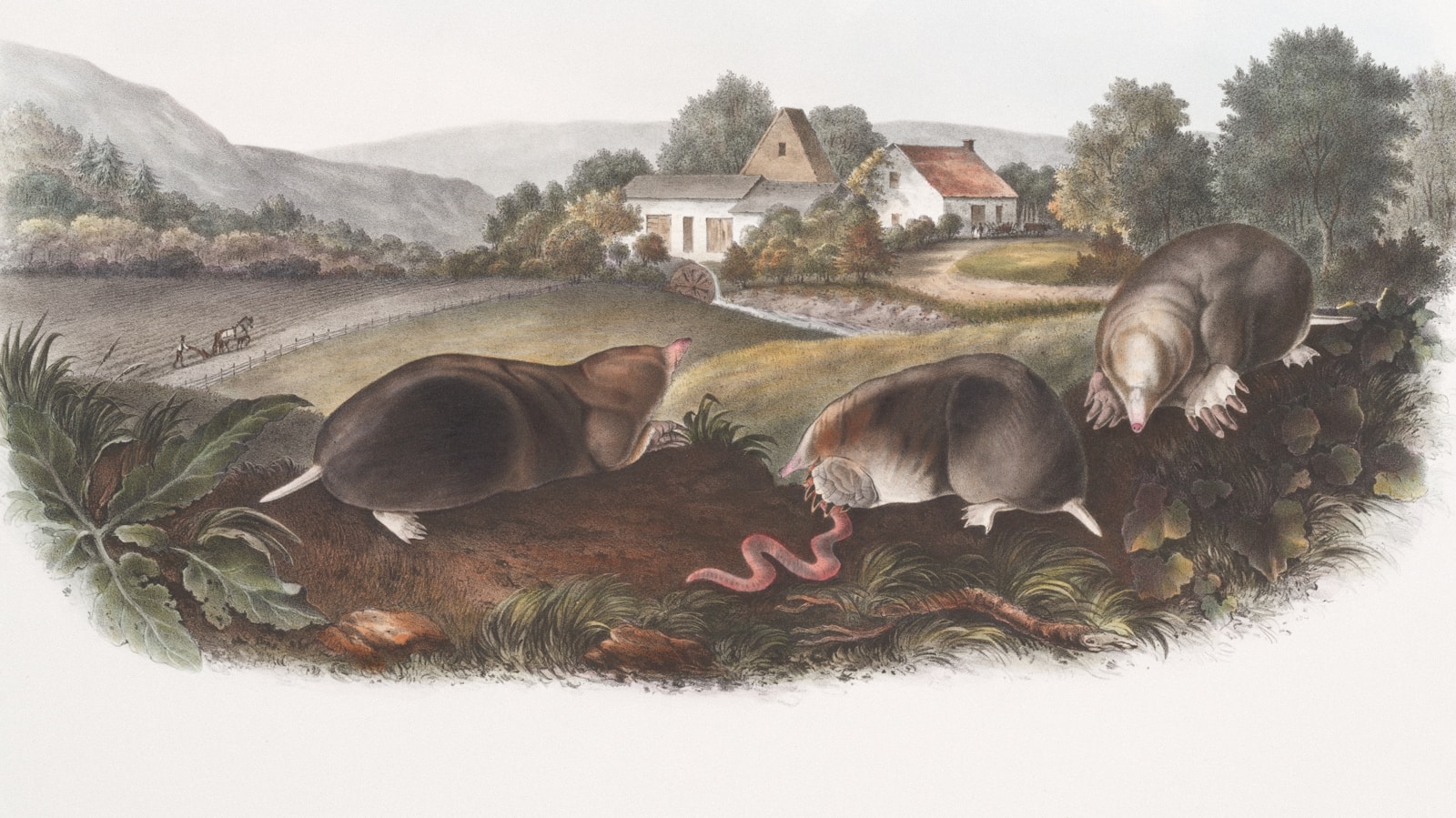
There is a call we get every spring that starts the same way: “The moles are back.” The homeowner has been fighting tunnels in the same stretch of lawn for three, four, sometimes five straight years. They assume a new crew of moles moves in every season, does its damage, and moves on. When we walk the yard and read the runs, the truth is usually simpler and a little more annoying. It was never a rotating cast. It was one animal, the whole time.
That is what a mole’s lifespan actually means for a lawn. The picture at the top of this post is a hand colored plate of American moles from Audubon’s Quadrupeds of North America, painted in the 1840s, and the scene it shows, moles working the soil at the edge of a farm lawn, is exactly what we still get called out to in Greater Cincinnati every week. This animal has been outlasting American homeowners for a very long time. Here is how long moles live, why so much of that life happens under one yard, and what it means for getting rid of them.
Key takeaways
- Eastern moles that survive their first year typically live about 3 years in the wild, and adults can reach roughly 6. A mole problem is measured in years, not weeks.
- Most mole deaths happen young, during the few weeks juveniles travel above ground to find territory. Once an adult claims a yard, it has almost no predators underground.
- An adult mole holds the same territory for life. The "moles" wrecking a lawn every spring are very often one long-lived animal working the same tunnel system.
- Waiting a mole out is not a plan. Three to six years is longer than most homeowners will tolerate a torn up lawn, and an empty tunnel system attracts the next mole anyway.
- Trap Your Moles provides guaranteed mole removal across Greater Cincinnati, Northern Kentucky, and Southeast Indiana. Get a free phone estimate, no sales visit needed, at 513-518-5639.
How Long Do Moles Live?
Eastern moles, the species in Ohio, Kentucky, and Indiana yards, average about 3 years in the wild once they reach adulthood, and individual moles can live to roughly 6. Mortality is heaviest in the first months of life, while young moles travel above ground looking for territory of their own.
The eastern mole is not the short-lived pest people assume it is. Field studies on this species put the average adult lifespan at around 3 years, with individual animals documented in the 5 to 6 year range. For a small mammal, that is a long run. A cottontail rabbit in the same yard would be lucky to see 18 months. A mouse rarely sees one winter.
The reason moles do so well is the same reason they are hard to deal with: they live in a fortress. Nearly everything that would eat a mole cannot reach it, a point we broke down in what eats moles. Hawks and owls cannot see through sod. Foxes and coyotes can smell a mole but rarely commit to excavating one. Once an eastern mole is established in its deep tunnel system, its main threats are drought, flooding, and other moles. That is why the lifespan numbers split so sharply by age: a mole that survives its first summer has very good odds of surviving several more.
One honest caveat, because you will see different numbers online. Much of what is written about mole lifespan comes from studies of the European mole, a different species on a different continent, and plenty of American lawn care pages quote those figures without noticing. The two species live similar lifespans, about 3 years on average with a ceiling near 6, so the practical answer for your yard does not change. But when you read a page describing moles surfacing in British pastures, you are not reading about the animal under your Cincinnati lawn.
Why Do So Many Young Moles Die in Year One?
Because dispersal happens above ground. Female moles raise one litter of 3 to 5 pups each spring, and at about 5 to 6 weeks the young must leave and find territory. That trip often happens on the surface, where owls, hawks, foxes, cats, and cars kill a large share of them.
A female eastern mole raises one litter a year, usually 3 to 5 pups, born in early spring in a nest chamber a foot or more down. The pups grow fast. By late spring they are weaned, and by about six weeks the mother is done with them. Her tunnel system feeds one mole, and she is not sharing it.
So the young disperse, and this is the most dangerous month of a mole’s life. Some push out through shallow runs, but many travel over open ground, at night, through territory they do not know. Every predator that spends the rest of the year unable to touch a mole gets its one chance. Owls take them. Foxes and cats take them. A surprising number end up flattened on roads in late May and June, which is often the only time a homeowner ever sees a whole mole above ground.
The young that survive claim vacant ground, dig in, and mostly never surface again. This is the filter that shapes the whole lifespan curve. A mole’s life is brutally risky for about six weeks and remarkably safe for years afterward. It also explains a pattern we see on service calls every June: a yard that never had moles suddenly has fresh shallow runs. That is not an infestation. That is one dispersing juvenile, newly arrived, testing whether your lawn is worth claiming.
Does One Mole Really Hold the Same Yard for Years?
Yes. An adult eastern mole claims an exclusive territory, often around an acre, and defends it against other moles for the rest of its life. Outside of brief spring breeding contact, moles live alone. The recurring damage in one yard year after year is usually the same individual animal.
Moles are fiercely territorial loners. An adult holds a tunnel system that can cover an acre or more, alone, as we covered in how many moles are in my yard, and it does not wander off to try other neighborhoods. Why would it? The deep runways took real work to dig, they sit below frost and drought as we mapped in how deep moles dig, and the territory holds a food supply the mole knows tunnel by tunnel.
Put the lifespan next to the territoriality and the math on your “recurring” mole problem changes. Three to six years of adult life, one animal per territory, and a territory the size of a suburban lot or two. The moles that tore up your yard in 2023, 2024, and 2025 were very likely the same mole. When homeowners in Anderson Township or Florence tell us they get new moles every spring, what they usually have is one long-term resident whose work schedule makes it look that way.
The seasonal disappearing act sells the illusion. Damage shows in spring and fall, then stops in summer and winter, and people reasonably conclude the moles left. They did not. As we explained in do moles hibernate, the animal just follows the earthworms deeper when the surface gets too dry or too cold, keeps feeding from its permanent runs, and comes back up when conditions soften. The lawn was never vacant. The landlord was in the basement.
What Does a Mole Do With All Those Years?
It digs, eats, and expands. A mole must eat close to its body weight daily, so every year of life means hundreds of feet of new feeding runs, more molehills from deep excavation, and a wider, more established tunnel network. The older the resident mole, the bigger the yearly damage tends to be.
A mole’s metabolism never gives it a day off. The animal has to eat something close to its own body weight in earthworms and grubs every day, a menu we covered in what ground moles eat, and that food bill is paid in digging. In good soil a mole can add 100 feet or more of shallow feeding run in a single day, working the dawn and dusk shifts we detailed in when moles are most active.
Now multiply that by a 3 to 6 year lifespan. An established adult is not starting fresh each spring. It is maintaining and extending a network it has been building since the year it arrived: deep highways connecting the best hunting grounds, a den under a stump or slab edge, and a seasonal rotation of feeding areas it knows the way you know your own kitchen. This is why the damage in year three is usually worse than year one, and why an old resident mole can heave more soil in a wet April week than a young one manages all season.
We can usually tell on a walkthrough whether we are dealing with a new arrival or a long-term resident. Fresh, scattered, shallow runs that wander without pattern say juvenile. A yard with established mound lines, repaired ridges along the same fence row every year, and deep runs the animal rebuilds within a day of being crushed says resident with tenure. The second yard is the one where “wait and see” has already failed for years.
Do Moles Come Back After One Dies or Leaves?
The tunnels outlive the mole, and vacant tunnel systems attract replacements. When a resident mole dies or is removed, a dispersing mole from nearby woods or fields can eventually claim the empty network. Good habitat gets recolonized, which is why removal has to be paired with watching for new activity.
Here is the part of the lifespan story most pages skip. The mole is mortal, but the real estate is not. A deep runway system represents years of excavation, and when its owner dies, that infrastructure sits there, intact, an inheritance waiting for the next mole. Dispersing juveniles do not have to earn a territory by digging one from scratch if they stumble into a vacant network with the previous owner’s worm supply still in it.
So mole pressure on a yard is really about habitat, not about any individual animal. A property backing up to woods, a creek, a park, or open field in Greater Cincinnati sits on a supply line of dispersing moles every June. That is not a reason to shrug and live with it. It is a reason to be realistic: removing the current resident fixes the damage now, and the yard still deserves a glance each spring for new shallow runs. Catching a newcomer in week one, while it is a single uncertain juvenile testing the ground, is a far smaller job than evicting an established adult in year three. Either way, one animal at a time is the honest arithmetic, because that is how moles actually occupy ground. The same question comes up after a removal rather than after a natural death, and the timing and the telltale signs are different enough to be worth their own page: see do moles come back after trapping.
Why Does Mole Lifespan Matter for Getting Rid of Them?
Because every wait-it-out strategy is betting against an animal that can hold your lawn for 3 to 6 years. Repellents and home remedies do not shorten that tenancy, they just relocate the visible damage for a while. Removing the resident animal by trapping is the only outcome the lifespan cannot outlast.
Knowing the animal under the lawn is likely three years into a six year lease changes how you judge every option on the table.
Waiting is the first casualty. “Maybe they’ll move on” is a fine plan for a migrating flock, and a terrible one for a territorial animal with no reason to leave and years left to live. We have walked yards where the homeowner had been waiting out “this year’s moles” since before the pandemic, re-seeding the same ruts every fall. The mole was collecting rent the entire time.
Repellents fare no better against that timeline. As we showed when we tested castor oil for moles, the best case for a repellent is pushing activity to a different part of the territory for a few weeks, after which the resident, who is not going anywhere for years, resumes using the ground it owns. And the poison route is one we refuse on principle and on results: poisons in a lawn are a risk to pets, kids, and the owls and foxes that eat moles, and they reliably fail anyway because moles want live earthworms, not bait. A long-lived animal punishes half measures, because it is still there when the half measure wears off.
What actually ends the tenancy is removal. Trapping moles works with the animal’s biology instead of against it: the trap sits in a run the mole must patrol, and its own lifestyle, the daily rounds it has kept for years, brings it there. The lifespan that makes waiting hopeless is exactly what makes trapping reliable. A creature of habit with years of habits is a creature you can intercept.
How Do You End a Multi-Year Mole Problem for Good?
Identify the active runs, trap the resident animal, confirm activity has stopped, and then watch for newcomers each spring. That is our whole method at Trap Your Moles, and it is guaranteed. One free phone estimate at 513-518-5639 tells you exactly what your yard needs, no sales visit required.
The playbook against a long-term resident is short, and it is the one we run on mole removal jobs across the region every week.
First, read the yard. Not every ridge is live. We flatten test sections and find the runs the mole actually patrols, the main routes it has maintained for years, because those habits are the animal’s weak point.
Second, trap the resident. Traps go in the active runs, matched to the run depth and the soil. On most lawns there is one adult to remove, and when it is gone, the digging stops. Not slows. Stops. That is a clean, checkable result, and it is why we can put a guarantee behind the work.
Third, verify and watch. We confirm the yard has gone quiet, and we tell you honestly what your property’s re-invasion risk looks like based on what borders it. A yard in the middle of a subdivision may stay mole-free for years. A yard backing onto a wooded creek in Cincinnati or Northern Kentucky should get a spring walk-around, and a fast call if new runs show up, while the newcomer is young, inexperienced, and easy to intercept.
We are a licensed and insured local company, we have read thousands of these yards, and the animal has not changed since Audubon painted it: durable, territorial, and very patient. The fix is being more patient than the mole is, or skipping the multi-year standoff entirely. Get a free phone estimate, no sales visit needed, at 513-518-5639, or reach us here and tell us what your lawn has been doing. If it has been doing it for years, now you know why.
Common Questions
How long do moles live in a yard?
As long as they live at all. An adult eastern mole claims an exclusive territory and holds it for life, typically about 3 years and sometimes up to 6. Unless the animal is removed or dies, the mole damaging a lawn this spring is usually the same one that damaged it last spring.
Do moles die off in winter?
No. Moles do not hibernate and winter does not cull them. When frost hardens the surface, the mole simply feeds from its deep tunnels below the frost line, out of sight. The quiet winter lawn reflects where the animal is working, not whether it survived. Activity resurfaces when the ground thaws.
What kills most moles?
Youth, not age. The heaviest mortality hits juveniles during spring dispersal, when they travel above ground to find territory and are exposed to owls, hawks, foxes, cats, and traffic. Established adults are largely safe underground, which is why a mole that claims a yard tends to keep it for years.
How long until a new mole takes over after one is removed?
It depends on what borders the yard. Vacant tunnel systems can attract dispersing moles, most of which travel in late spring. Yards near woods, creeks, and fields see newcomers sooner, sometimes the same season, while isolated suburban lots often stay quiet for years. A spring check for fresh runs catches arrivals early.
Do moles live longer than mice and other yard rodents?
Much longer, and moles are not rodents at all. They are insectivores, related to shrews. A wild mouse rarely survives a full year, while an adult eastern mole averages about 3 years and can reach 6, protected underground from most predators. That long lifespan is why mole damage recurs in the same yards.
Image: “Common American Shrew Mole” from Audubon’s The Quadrupeds of North America (1845 to 1848), via The New York Public Library on Unsplash