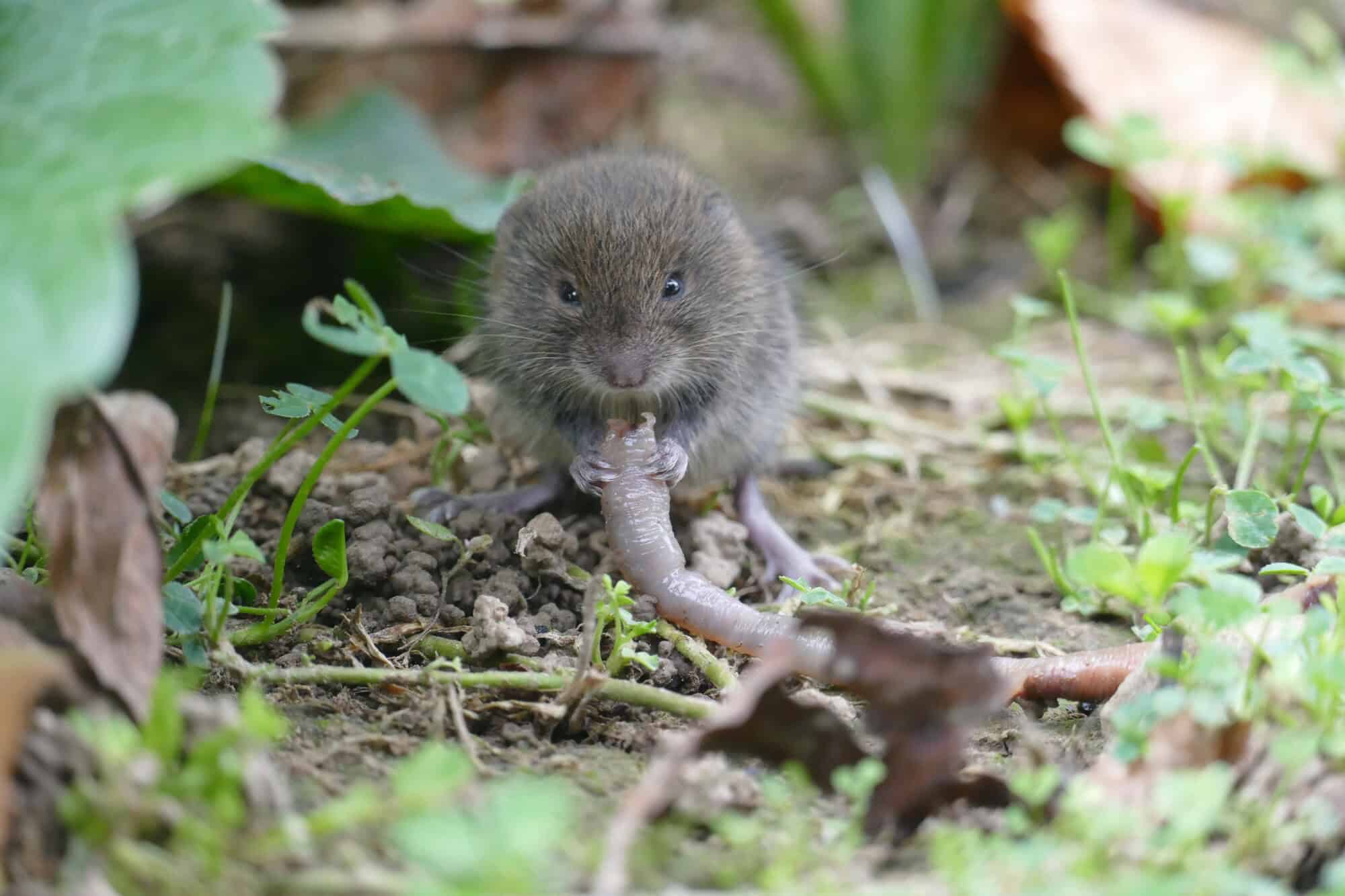
The fast answer: if the lawn has raised ridges you can feel underfoot and cone-shaped dirt mounds with no visible hole, you have moles, which eat insects and live underground. If you see narrow trampled runways clipped through the grass at ground level, open holes with no mound, or gnaw marks on bark, bulbs and roots, you have voles, which are plant-eating rodents. They need completely different treatments, so identifying the animal correctly is step one.
The names are one letter apart, both animals tunnel, and both get blamed for whatever is wrong with a lawn. But they are not close relatives. A mole is an insectivore built like a digging machine. A vole is a rodent, closer to a field mouse than to anything in a mole’s family tree. Once you know which signs belong to which animal, telling them apart in your own yard takes about ten seconds.
The 10-Second Diagnosis Table
| What you see | Mole | Vole |
|---|---|---|
| Raised ridges in the turf | Yes, spongy underfoot, they collapse when stepped on | No |
| Soil mounds | Yes, symmetrical cone shape, no entry hole visible | No |
| Open holes in the lawn | Rare | Yes, dime to golf ball size, no soil mound |
| Surface runways | No | Yes, one to two inches wide, grass clipped to the soil |
| Chewed bark at the base of trees | No | Yes, especially under winter snow cover |
| Hollowed bulbs, roots, tubers | No | Yes |
| Plants wilting or dying | Only from root disturbance | Yes, the roots are being eaten |
| Animal seen above ground | Almost never | Often, darting between cover |
| What it eats | Earthworms, grubs, soil insects | Grasses, roots, bark, bulbs, seeds |
| How many are usually present | One to three per lawn | Colonies, populations can spike fast |
If you only remember one line from that table, make it this one: moles do not eat plants. A mole has the wrong teeth and the wrong digestive system for vegetation. So the moment you find something chewed, you have stopped looking at a mole problem.
What Mole Damage Actually Looks Like
Moles hunt by patrolling a tunnel network, and both types of tunnel leave a signature.
Surface feeding tunnels are the raised ridges snaking across the lawn. The mole is swimming through the top few inches of soil after earthworms, lifting the turf as it goes. Press one down with your foot and it gives way easily. If it is repaired within a day or two, that runway is active.
Deep runways sit roughly a foot down and serve as permanent highways between feeding areas and the nest. Excavating them produces spoil that has to go somewhere, and that is what a molehill is: soil pushed vertically up a short shaft and out onto the surface in a neat cone. There is no open doorway in the side of it. The shaft plugs behind the mole.
The damage is real, but it is mostly turf damage. Roots get lifted and dry out, the lawn feels spongy, mower blades catch on mounds. What you will not find is a plant that has been eaten.
What Vole Damage Actually Looks Like
Vole damage reads completely differently, because a vole is a rodent doing rodent things at ground level.
The signature sign is the surface runway: a one to two inch wide path worn through the lawn where voles travel the same route over and over, with the grass clipped down to the soil along it. The network looks like a trail map pressed into the turf. Along those runways you will find small open holes, clean-edged, with no cone of soil around them.
Then there is the feeding damage. Voles gnaw bark from the base of young trees and shrubs, and if they ring the trunk completely the plant dies, sometimes not until the following summer when it tries to push new growth and cannot. They hollow out tulip and crocus bulbs, take bites out of potatoes and carrots, and chew roots below the surface.
Winter is when it gets expensive. Snow cover gives voles a roof to work under, hidden from hawks and owls, and they will feed on bark all season. Plenty of homeowners have no idea they had voles until the snow goes and the lawn is revealed covered in runways.
What Each One Looks Like Up Close
You will rarely get a look at a mole. They spend almost their whole lives below ground, surfacing only occasionally for nesting material. If you do see one, it is unmistakable: about five to seven inches long, velvety dark gray to brown fur, an elongated pink snout, and oversized paddle-shaped front feet turned outward for digging. The eyes are tiny and buried in fur, and there are no external ear flaps at all.
Voles are the ones you actually see. They look like a stocky field mouse: roughly four to seven inches nose to tail, brown or gray fur, small visible black eyes, small ears often half hidden in fur, a blunt nose, and a tail noticeably shorter than a house mouse’s. They spend a lot of time above ground and move in quick dashes between patches of cover.
Why the Tunnels Confuse Everybody
Here is the wrinkle that sends most people down the wrong path. Voles will move into tunnels a mole dug. Given a ready-made underground network, a vole is not going to excavate its own deep runs. It will use the mole’s, and add its own surface openings.
So a yard can genuinely show mole ridges, mole mounds, vole runways and chewed bulbs all at once, and it does not mean one animal is doing all of it. It usually means you have both, or that the moles moved on and the voles inherited the real estate.
This is also why “I got rid of the moles and the damage continued” is such a common story. The tunnel system outlives the mole that dug it.
The Fix Is Different for Each One
This is the part that matters, and it is why guessing costs people a season.
Moles are controlled by mechanical trapping placed inside an active underground runway. There is no bait involved, because a mole will not take one. Success comes down to reading the tunnel system correctly and setting to the true depth of a runway you have proven is in use. We walk through the whole method in our guide to how mole trapping works, and the full range of options is ranked in how to get rid of moles in your yard.
Voles need a combination. Trapping goes in the surface runways, not underground, and it works because voles are creatures of habit that reuse the same paths. Alongside that, the habitat has to change or a new colony simply replaces the old one: cut heavy ground cover back, pull mulch away from trunks, keep the grass mowed short where the lawn meets beds and field edges, and put guards around the base of young trees before winter.
A mole trap set for a vole catches nothing. A vole trap set in a mole runway catches nothing. Correct identification is not a technicality, it is the whole job.
Who to Call When Something Is Digging Up Your Yard
If you are in Greater Cincinnati, Dayton, Northern Kentucky or Southeast Indiana and the lawn is showing raised ridges, dirt mounds, surface runways or fresh holes, call Trap Your Moles at (513) 518-5639. The line is answered 24 hours a day. A technician comes out, identifies the animal, and sets the right trap in the right spot. Mechanical and live trapping only, no poisons, free estimates.
- Mole removal for raised ridges and cone-shaped mounds
- Vole removal for shallow surface runways and chewed plants
- Groundhog removal for one wide burrow hole by a shed or deck
- Chipmunk removal for clean two-inch holes along a foundation
- Not sure which one? The identification table on our services page walks through each animal, or get a quote and describe what you are seeing.