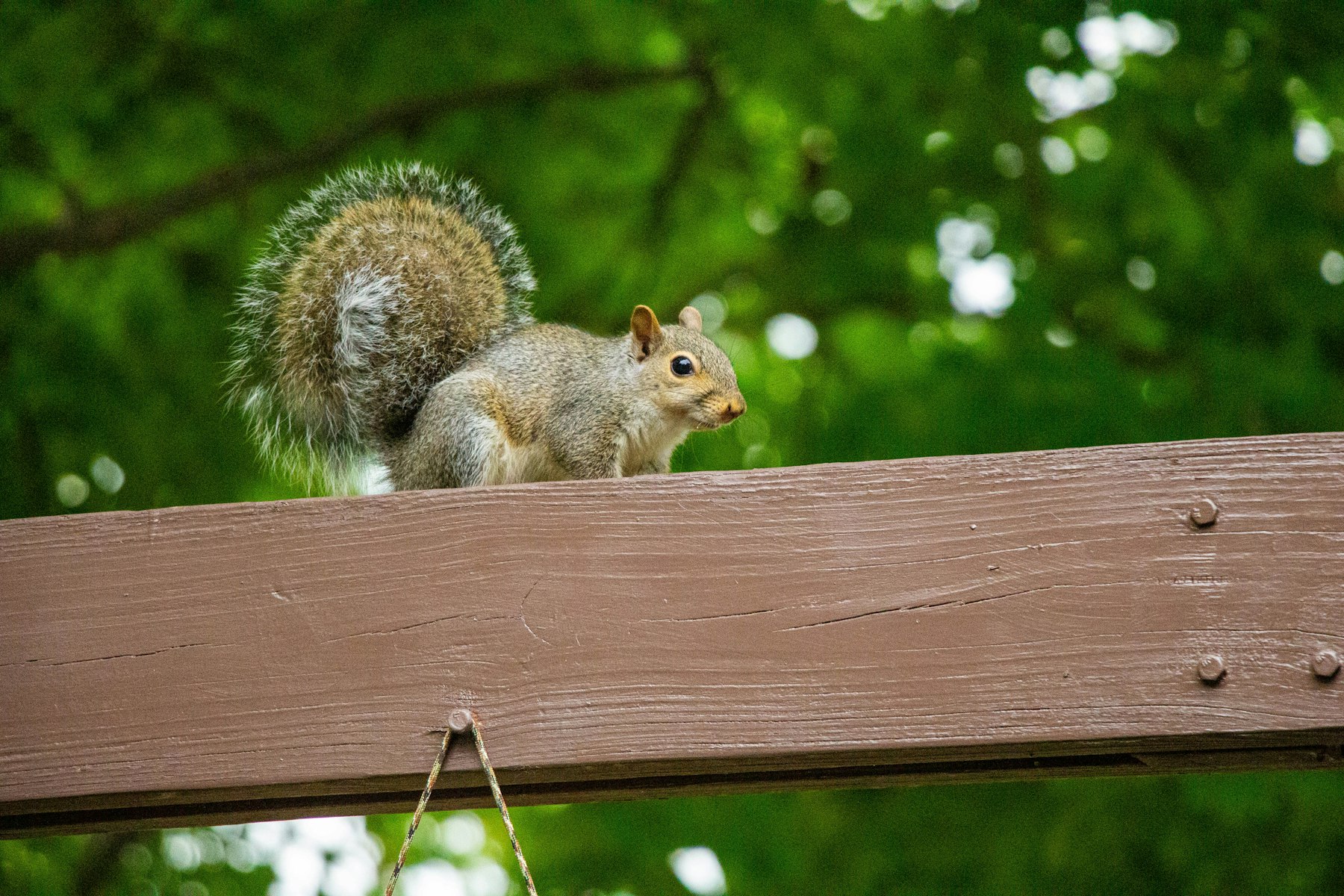
The homeowner had already fixed it. That was the first thing he told me on the phone. He got up on a ladder in April, found the hole above the gutter where the roof met the siding, packed it with expanding foam, and screwed a piece of hardware cloth over the top. The noise stopped for about nine days. Then it came back six feet to the left, in a spot that had been perfectly solid all spring.
That is the most common squirrel call we get around Greater Cincinnati, and the frustrating part is that he did not do anything wrong. He found a real hole and closed it properly. The problem is that closing the hole was never the whole job, because the hole is not the reason the squirrel is there. That difference is what separates a roofline you fix once from one you keep fixing every spring.
Key takeaways
- Squirrels almost always enter along the roof line, where the roof deck meets the exterior wall, not through the middle of a roof. Gable vents, rotted fascia, and the corner where a dormer ties in are the other three usual doors.
- They come back because a gray squirrel keeps several den sites inside one territory and returns to them by memory. Sealing one opening removes a door, not the animal's reason for being on your roof.
- A used attic keeps drawing squirrels after the original family is gone. Old den scent reads as a proven safe nesting site to the next squirrel that comes along.
- The two invasion windows here are late winter, roughly February into March, and again late summer into early fall. Both are driven by females looking for an enclosed place to have young.
- Sealing an entry while a litter is still inside is the mistake that turns a manageable job into an expensive one. The mother does not leave. She opens a new hole, usually within a few feet of the old one.
How Do Squirrels Get Into an Attic?
Squirrels get in along the roof line, where the roof deck overhangs the exterior wall and the soffit ties in. Other common doors are gable and ridge vents, rotted fascia board, the inside corner where a dormer meets the main roof, chimney chases, and attic fan louvers. They enlarge small existing gaps by chewing.
A squirrel does not pick a random spot on your roof and start chewing. It runs the edges. It travels the gutter line, the ridge, and the valleys, and it stops wherever it feels air moving or finds a seam that gives when it pushes. Almost every entry point I find sits on the perimeter of the roof, which is the part of a house you cannot see from the ground or from inside the attic without crawling out to the eaves.
The most common door in this market is the roof line gap. On a lot of older homes here, through Hyde Park, Mount Lookout, Clifton and Northside, the roof deck was built out over the wall and the soffit fitted underneath afterward. Where those two planes meet there is often an inch of space behind the gutter, hidden by the drip edge. A squirrel finds it with its nose, works a paw in, and the wood does the rest. Gray squirrel incisors never stop growing, so gnawing is not an effort for them. It is maintenance they have to do anyway, and your fascia board is a convenient place to do it.
After that it is a short list. Gable vents with the screen rusted loose. Fascia gone soft behind a gutter that has been overflowing for a few seasons, which is a very Cincinnati problem given the wet leaf load our canopy drops. Brittle ridge vent baffles, lifted chimney chase seams, exhaust vents with the damper flap broken off. What gets them up there in the first place is almost always a branch, because gray squirrels travel through canopy and clear an eight foot gap without much thought. A limb ending six feet off your roof is not a safe distance.
Why Do Squirrels Keep Coming Back After You Seal the Hole?
Because the hole was a door, not the attraction. A gray squirrel maintains several den sites inside one territory and navigates back to them by memory, so closing one entry leaves it standing on the same roof looking for the next weak spot. Old den scent also signals a proven nesting site to squirrels that arrive later.
A gray squirrel does not live in one place. Inside its home range it keeps a handful of dens and rotates through them: a leaf nest wedged in a fork forty feet up, a hollow limb, the neighbor’s soffit, your attic. When one becomes unavailable the animal does not leave, because it is attached to the territory, not the den. It shifts to the next spot on the list and starts probing for a way back into the good one. Your attic is the good one. It is dry, dark, holds heat in February, and nothing can reach it. Losing that is worth real effort to a squirrel.
Memory is better than people expect. This is the same animal that caches hundreds of nuts across a yard in October and recovers a good share of them months later under snow. Relocation trades on the hope that a squirrel will not find its way home, and the research on grays does not support that hope. Animals moved several miles have been documented working their way back. So when somebody tells me they live trapped four last spring, released them at a park, and still had squirrels by June, I do not assume they got unlucky.
The last piece is scent, and it catches the people who did everything else right. An attic that has held a den carries urine, droppings, and body oil worked into the insulation and rafters. To the next squirrel prospecting your roof line in August, that is not contamination. It is a recommendation. It says another squirrel raised young here and survived, which is exactly what an animal shopping for a natal den wants to know. That is why a house that has had squirrels once tends to get them again, and why clearing the nesting material is part of the job every time.
Put those together and the April phone call stops being mysterious. He closed one door on a building that still had an occupant with a strong reason to be inside and several other ways to try.
What Time of Year Do Squirrels Move Into Cincinnati Attics?
Two windows, both tied to breeding. The first runs from roughly February into March, when females look for an enclosed den for a late winter litter. The second runs from late summer into early fall for the second litter and for young of the year claiming territory. Cold snaps also push squirrels indoors outside those windows.
Eastern gray squirrels, the ones in nearly every yard from Batavia to Florence, breed twice a year. That is the whole calendar in one sentence, and it predicts our phone almost perfectly.
Late winter is the heavier of the two. A female carrying a litter in February is not satisfied with a leaf nest in a maple during an Ohio Valley cold snap, so she starts testing structures. The chewing is aggressive because she is on a deadline. Late summer into early fall brings the second wave, and it is messier: the second litter plus the spring young dispersing to find their own territory. Instead of one animal working one spot you often have three or four probing a whole roof line.
Outside those windows the trigger is weather. The first hard cold in November moves animals that had been content in a tree. If you are going to inspect a roof line once a year, do it in January, before the February push, while you can still get it closed on your own schedule instead of ours. Timing also changes what we can responsibly do on a job, because from late February through April, and again from August into September, there is a real chance of dependent young up there.
What Damage Do Squirrels Do in an Attic?
The serious damage is chewed electrical wiring, which is a genuine fire risk, plus insulation that gets compacted and soiled until it stops insulating. Add gnawed HVAC flex duct, urine staining through ceiling drywall, and nesting debris packed into soffit vents, which blocks airflow and creates a moisture problem in the roof deck.
Homeowners tend to be worried about the noise and unbothered by the rest, which is backwards. The noise is the cheapest part of a squirrel problem.
Wiring matters most. Squirrels gnaw to keep their incisors worn down, and romex insulation is close to the ideal texture for it. In an attic they are chewing cable that runs to ceiling fixtures, in direct contact with blown in insulation and dry framing. I have pulled nesting material out of attics with bare copper showing eighteen inches away. That is not a hypothetical risk, and it is why I will not tell somebody to just wait a squirrel out.
Insulation is the quiet expense. Squirrels tunnel through blown in cellulose, pack it into runways, and use one corner as a latrine the whole time they live there. Compacted insulation has lost most of its R value, because the loft is the insulation, and soiled insulation has to come out rather than get fluffed back up. The homeowner never saw it happening because it is all above the drywall. Then the rest: flex duct chewed open so you are heating the attic, nesting material stuffed into soffit bays cutting off roof ventilation, and urine working through the ceiling as a spreading brown ring.
Will Squirrels Leave the Attic on Their Own?
An animal that fell down a chimney or slipped through an open window will leave if you give it a clear exit. A squirrel that chewed its own entry will not, because it is not trapped or lost. It chose the space as a den. It will keep using it, and if there are young inside it will not leave under any circumstances.
Waiting works exactly once, in the accident case. Something came down the chimney flue or in through a garage door that was up, and it wants out more than you want it out. Open a path, close the interior doors, leave the room, and it will find daylight.
Everything else is a den, and a den does not get abandoned because you are annoyed. The animal leaves every morning to forage and comes back every evening, which is why so many homeowners tell me the noise seemed to stop and then returned a few days later. It never stopped. They happened to listen during the hours the attic was empty. That daily rhythm, right around first light and again in the last hour before dark, is also one of the more reliable ways to separate a squirrel from a raccoon, which works at night and sounds much heavier.
The version of waiting that goes badly is waiting during a litter. Young squirrels stay in the nest around two and a half months before they move on their own. Seal the entry in that window and you have separated a mother from her young, and she will chew a new opening to reach them. When somebody describes fast scampering plus a faint high pitched chattering, we stop talking about sealing anything and start talking about timing.
What Does Professional Squirrel Removal Actually Involve?
A full inspection of the roof line to find every opening, not just the obvious one. Then removal of the animals, including any young, followed by exclusion: closing every entry with material a squirrel cannot chew through. Cleanup of contaminated nesting material comes last, and it is what keeps the next squirrel from reading your attic as a good address.
The inspection earns its keep, and it is the step a homeowner on a ladder almost always skips. We are not looking for the hole. We are looking for all of them, plus the soft spots that are not holes yet: fascia that gives under a thumb, a gable screen loose at one corner, a dormer valley that has separated. On most houses there is one active entry and two or three places that would have become entries within a year. Closing one and leaving the rest is how you end up back on the phone in nine days.
Removal depends on the season and on whether there are young, which is why we ask about the chattering. Getting the animals out and getting the building closed have to happen in the right order, and that order is not the same in March as it is in June. This is the part where doing it wrong is worse than doing nothing, because a sealed building with a live animal in it is a much bigger repair than the one you started with.
Exclusion is the permanent part. Squirrels chew through expanding foam, plastic, wood, and light aluminum screen without slowing down, so those buy a season at best. Openings get closed with heavy gauge steel mesh and metal, fitted and fastened rather than stuffed. That is the difference between a fix and a delay. Our squirrel removal service is built around that sequence, and the removal work is guaranteed. Cleanup finishes it, because closing the doors on a building that still smells like a nursery just moves the problem to next season.
How Do You Keep Squirrels Out for Good?
Take away the access and close the building properly. Trim limbs back at least eight to ten feet from the roof, keep gutters clear so fascia and soffit do not rot, and have every opening on the roof line closed with steel rather than foam. Repellents, ultrasonic devices, and mothballs do not hold a determined squirrel.
Start in the trees, because that is the road. A limb within eight feet of the roof is a bridge. Trimming back to ten feet is the most effective thing a homeowner can do without touching the house, and unlike most prevention advice it does not wear out. Then keep the roof edge sound, because nearly every roof line entry I find started as water damage. A gutter overflowing for two seasons softens the fascia behind it, and soft fascia is an invitation.
What does not work is worth saying plainly, because people spend real money on it. Ultrasonic repellers do not move squirrels. Mothballs and ammonia rags do not move a female with a litter. Predator urine granules wash out in the first rain. A radio in the attic annoys an animal for a couple of days and then becomes background. None of it changes the fact that your attic is the best den in the territory. Only closing the building changes that.
If you are hearing movement above the ceiling in Cincinnati, Batavia, Florence, Lawrenceburg, or anywhere else across our Ohio, Kentucky, and Indiana service area, call us at 513-518-5639. We work this exact problem every week, and we will tell you on the phone whether what you are describing sounds like squirrels, a chipmunk working the lower part of the house, or something heavier. Get a free phone estimate, no sales visit needed. For the earlier warning signs before it reaches the attic, see six signs you need squirrel trapping, and there is more prevention in our guide to keeping unwanted animals out of your yard. Homeowners in the city core can start at our Cincinnati wildlife removal page, and if the trouble is in the lawn rather than the attic, that is usually a mole problem instead.
Common Questions
What does a squirrel in the attic sound like?
Fast scampering and rolling sounds directly above the ceiling, heaviest right around first light and again in the last hour before dark. You often hear something being dragged or a nut rolling. Raccoons are much heavier and work at night. Mice are lighter, stay inside the walls, and are active well after midnight.
How big a hole does a squirrel need to get into an attic?
An adult gray squirrel fits through an opening around one and a half to two inches across. That matters less than it sounds, because it does not need to find one that size. It only needs a seam it can get its teeth into, and it will open the rest itself. Most entries I find started smaller than a quarter.
Can I just seal the hole once the noise stops?
This is the most common way a small job becomes a large one. Quiet does not mean empty, because squirrels leave to forage during the day and come back. Sealing during a litter traps young inside, and the mother will chew a new opening to reach them. Confirm the space is actually clear before anything gets closed.
Does trapping and relocating squirrels solve the problem?
Not on its own. Gray squirrels navigate back to a home territory from a considerable distance, and any animal you do remove leaves an open attic that the next one finds within a season. Removal only holds when the building is closed behind it and the old nesting material is cleaned out.
Are squirrels in the attic actually dangerous?
They are not aggressive toward people and they stay above the ceiling. The real danger is chewed electrical wiring in contact with dry insulation, which is a genuine fire risk. Secondary concerns are fleas and ticks carried in close to living space, contaminated insulation, and blocked roof ventilation causing moisture damage.
Photo by Damian Kim on Unsplash.