Most people who ask this are not curious about voles. They are standing next to a hosta reduced to stubs, or a young crabapple with a ring of bark missing at the base, and they want to know what ate it and whether it is coming back. The answer to the second part is usually yes, and the reason is the first part.
A vole is a plant eater. That one fact explains almost everything a homeowner notices, and it is the cleanest line between a vole and a mole problem. A mole is in your yard hunting animals that live in the soil. A vole is in your yard because your yard is lunch.
Key takeaways
- Voles are herbivores. They eat grass blades and stems, clover and other broadleaf weeds, seeds, roots, tubers, bulbs and tree bark, and they do not hunt insects.
- Moles are insectivores and eat earthworms and grubs, so the two animals are in your yard for completely different reasons and need completely different work.
- The diet shifts with the season. Green growth carries them through the warm months, and once that is gone they move onto roots and the bark at the base of young trees and shrubs.
- Voles do not hibernate. They feed year round, in short bouts day and night, under whatever cover hides them from hawks and owls.
- You cannot starve them out of a lawn, because the lawn itself is the food. Removing the animals comes first, and the planting and cover changes hold afterward.
What Do Voles Eat?
Voles eat plants. Grass blades and stems, clover and other broadleaf weeds, seeds, roots, tubers, bulbs, and the bark and soft tissue just under it on young trees and shrubs. They are rodents with continuously growing incisors, so they chew constantly, and almost nothing they eat is animal.
A vole lives inside its own food. Sitting in a run worn through your turf, it is already surrounded by breakfast on every side, which is why it does not range far and why the damage stays concentrated in patches rather than spreading evenly.
Two kinds turn up on calls across the Ohio Valley, and they feed a little differently. The meadow vole is the one most people meet, and it works at the surface, clipping grass and forbs along the runways it wears into the turf. The woodland vole, which a lot of people here call a pine vole, spends more of its time below ground and does more of its feeding on roots and tubers. That second one is why a plant sometimes dies with no visible chewing anywhere above the soil line.
What a trapper looks at is the cut. Vole feeding leaves a clipped look, stems bitten off at a slight angle and often left lying in the run like cuttings. Nothing torn, nothing pulled up, no soil pushed anywhere. That detail settles a lot of yard arguments before anybody sets anything.
Do Voles Eat Grass and Damage a Lawn?
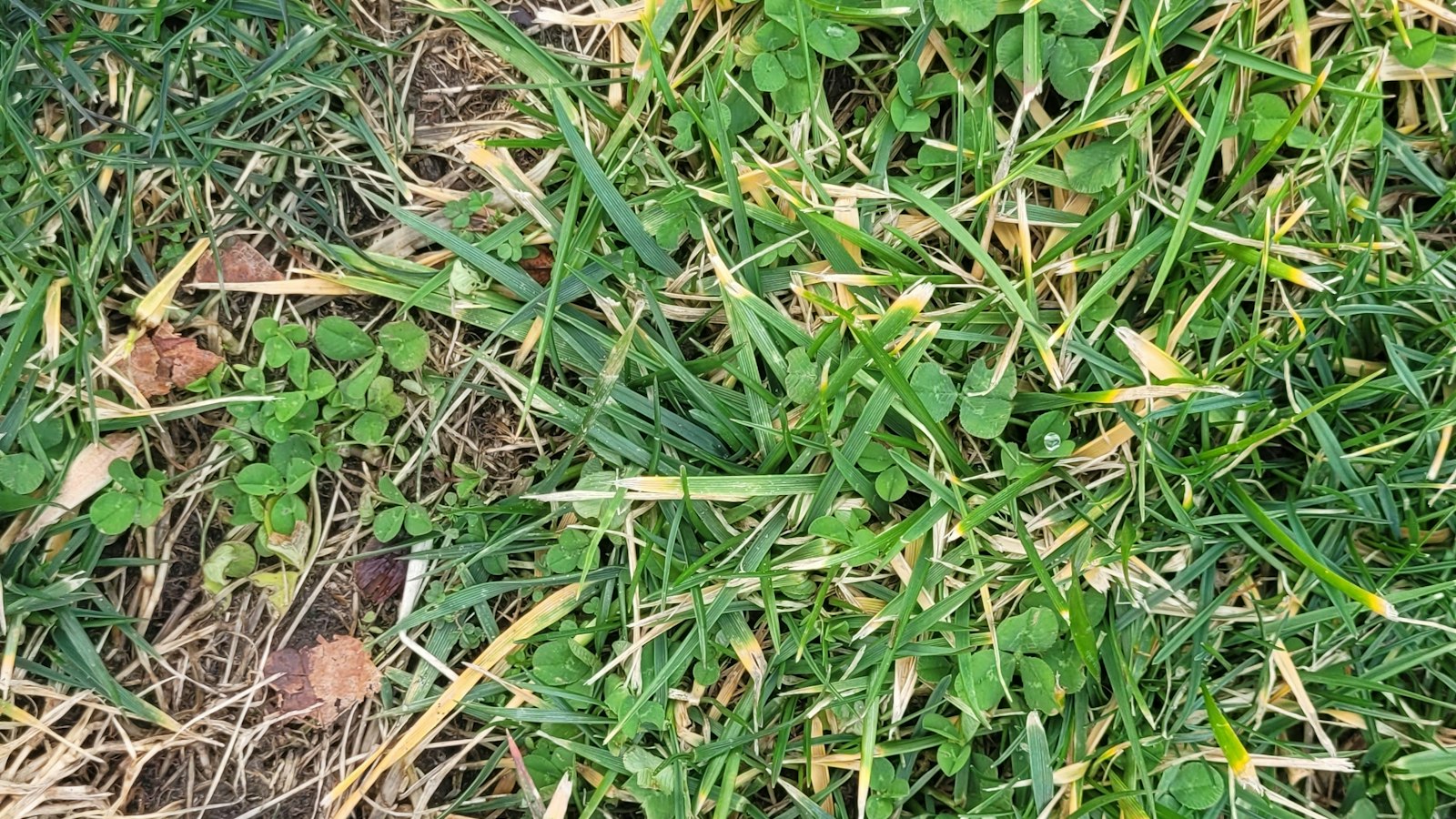
Yes. Grass blades and stems are a staple for meadow voles, and they feed along the same routes repeatedly. The result is a flat path worn and clipped into the turf, about an inch or two wide, with no raised ridge and no mound of soil, which is what separates vole damage from mole damage.
The pattern is the giveaway. A vole is a small animal out in the open with hawks and owls overhead, so it does not wander. It picks a route between cover and food, uses it over and over, and feeds as it goes. Over a season that route becomes a visible surface trail with the grass eaten down and the dead thatch pressed flat.
Those trails show up at their worst in late winter and early spring, which fools almost everybody, because the moment you see the damage is not the moment it happened. The network got built under cover and the melt just reveals it. We walk Northern Kentucky yards every year where the homeowner is certain it happened overnight, and it took the whole winter. That seasonal pattern is in our piece on why Kentucky lawns look chewed up in spring.
If what you are looking at is raised and spongy underfoot instead of worn flat, stop reading about voles. That is a mole, and the full side by side is in our guide to moles vs voles. The repair side of the vole version, once the animals are dealt with, is covered in what vole damage looks like in a lawn.
What Do Voles Eat in Winter?
Bark and roots, mostly. When the green growth is gone, voles move onto the bark and the soft cambium layer underneath at the base of young trees and shrubs, and onto roots and tubers below ground. This is when the expensive damage happens, because a tree chewed all the way around does not recover.
This is the part of the year that costs people real money, and nobody sees it happening. A vole wants a roof over its head while it eats. Snow cover, a mat of unmown grass, heavy leaf litter, mulch piled against a trunk. Under any of those it can feed all day without a hawk getting a look at it, and the green food it lived on in July is gone.
So it starts on bark. The marks are low, usually within a few inches of the ground, irregular, and cut at odd angles in short strokes, like someone went at it with a small rasp. Rabbits chew low too, but a rabbit leaves a cleaner angled cut on twigs and a smoother surface. The vole version is rougher and messier and it goes around rather than up.
Age is the pattern here. A mature oak with deep furrowed bark gets walked past all winter. The ones that get hit are young and thin barked: crabapples, young maples, fruit trees, burning bush, hydrangea, arborvitae. Mulch mounded against the trunk makes it worse, because it gives the animal somewhere to work unseen.
Going around is the whole problem. A tree moves water and sugar through the layer just under the bark, so a trunk stripped the full way around at the base is girdled, and that tree is finished whether it leafs out next spring or not. We have looked at plenty of young maples in March that were already dead and had not been told yet. If something in your yard is girdled part of the way around, talk to a nursery or an arborist before you spend another year watering it.
Do Voles Eat Plant Roots, Bulbs and Garden Plants?
Yes, and this is where woodland voles do most of their damage. They feed on roots, tubers and bulbs from below, so a plant can wilt, loosen in the soil or simply fail to come up with no chewing visible above ground at all. Tulips, crocus, hostas and young perennials are common losses.
The classic version of this call is a homeowner who planted bulbs in October, waited all winter, and got nothing in April. Or a hosta that looked fine, then tipped over sideways when they brushed past it, because the root mass underneath it was gone. Nothing above the soil ever looked wrong, so the usual suspects get blamed and the actual animal never gets dealt with.
To check, pull gently on the plant. One that lifts with almost no resistance has lost its anchor, which means something underground has been feeding on it. Then look for a clean hole about the size of a quarter with no soil heaped around it. Soil pushed into a cone or ridge is a mole. A clean open hole is a vole.
Holes bigger than that with a real pile of soil beside them are chipmunks or a groundhog.
Do Voles Eat Insects or Grubs Like Moles Do?
No. That is the single clearest difference between the two animals. Moles are insectivores and are in the yard hunting earthworms and grubs. Voles are herbivores and are in the yard for the plants. Treating a yard for insects does nothing to a vole population.
This is the reason so much money gets spent on the wrong product. Grub treatments get sold every year on the promise that killing the grubs removes whatever is digging up your lawn. Even for moles that logic is shaky, since earthworms are the bigger part of their diet and the tunnels stay. For voles it is simply irrelevant. A vole was never eating grubs.
The same goes for most of the things sold at the aisle end. Repellent granules, castor oil, sonic spikes pushed into the turf. We get called out behind all of them, and the pattern is always the same: the animal shifts its runs a little and keeps feeding, because the food supply has not changed and neither has the cover. Our honest position on that whole category is on the mole removal side of the site, and it applies here for the same reason.
Knowing which animal you have decides everything else. If you are not certain whether you are looking at a vole or something else small and brown, telling a vole from a mouse walks through it.
Can You Get Rid of Voles by Taking Away Their Food?
No, not in a maintained yard. The lawn, the beds and the landscaping are the food, and you are not removing those. Cutting cover and pulling mulch back off trunks makes the property less attractive, but voles already living in it have to be trapped out before any of that holds.
This comes up on nearly every vole call, usually phrased as a hope rather than a question. We would tell you if that version existed.
Here is the honest sequence, the same one we give on the phone. The animals come out first. Then the turf repair, the mulch pulled back so there is bare ground at the base of young trees, the grass kept cut into late fall rather than left to mat down. Done in that order it holds. Done in the other order you are repairing a lawn that is still occupied, and by June you are looking at fresh runs through the new grass.
Trapping is how the first half gets done, and on this kind of work it is mechanical. No poisons and no chemicals are involved in trapping voles, which matters to the people asking because their kids and their dog use that yard. What it takes is reading the property: finding the live runs rather than the abandoned ones, working out which cover is feeding the network, and moving sets as the pattern shifts.
Who Should You Call About Voles in Greater Cincinnati?
Call a trapper rather than a lawn service. A lawn company repairs the turf, which is the symptom. Trap Your Moles is licensed and insured, works across Greater Cincinnati, Dayton, Northern Kentucky and Southeast Indiana, and gives a free phone estimate at 513-518-5639 with no sales visit needed.
What we do first on a vole removal call is read the property before anything gets set. Where the live runways actually are, which beds and which cover are feeding them, whether the young trees have bark damage you have not spotted yet, and whether there is a mole problem running alongside the vole problem, which happens far more often than people expect. Then the sets go where the traffic is and get moved as the animals shift.
We work the whole tri state, including Cincinnati, Dayton and the Northern Kentucky and Southeast Indiana suburbs. Satisfaction guaranteed means what it sounds like: we do what it takes to get the yard right.
If you have a plant that lifted out too easily this fall, or a ring of missing bark at the base of something young, call us at 513-518-5639, Monday to Friday, 8 AM to 6 PM Eastern. A free phone estimate costs nothing and we will tell you honestly whether it is a vole, a mole, or something else.
Common Questions
What do voles eat the most?
Green plant material, for most of the year. Meadow voles feed heavily on grass blades and stems along their runways, plus clover and other broadleaf weeds growing in the turf, and they take seeds when those are available. Woodland voles, which many people here call pine voles, do more of their feeding below ground on roots and tubers. In winter, when green growth is gone, both shift onto roots and onto the bark and soft layer underneath at the base of young trees and shrubs.
Do voles eat grass roots?
Yes. Roots are part of the diet year round and become a much bigger part of it in winter. Woodland voles in particular work below the surface and feed on roots and tubers, which is why a plant can loosen in the soil, wilt or fail to come up in spring with no visible chewing anywhere above ground. If a perennial or a young shrub lifts out with almost no resistance when you pull on it, the root mass underneath has usually been fed on.
Do voles eat insects or grubs?
No. Voles are herbivores and eat plant material. The animal that eats grubs and earthworms in a yard is the mole, which is an insectivore, and that difference is the main reason the two problems need different work. It also means grub control products do nothing about voles, because voles were never eating grubs in the first place. If something is clipping grass along flat surface trails, that is a vole and an insect treatment will not change it.
What do voles eat in the winter?
Bark, the soft cambium layer just under it, and roots. Once green growth dies back, voles feed at the base of young thin barked trees and shrubs, usually within a few inches of the ground, under the cover of snow, leaf litter or mulch piled against the trunk. The chewing is irregular and cut at odd angles in short strokes. A trunk stripped the whole way around is girdled, and that tree will not recover even if it leafs out the following spring.
Will voles eat my flower bulbs?
They can, and tulips and crocus are common losses around Greater Cincinnati. Voles feed on bulbs and tubers from below, so the usual sign is simply that nothing comes up in spring, with nothing visibly wrong at the surface over the winter. Look for clean holes about the size of a quarter with no soil mounded beside them in or near the bed. A cone or ridge of pushed up soil points at a mole instead, which is a different animal and a different fix.
Can I get rid of voles by removing their food?
Not in a maintained yard, because the lawn and the landscaping are the food and you are not removing those. Cutting cover helps the property resist them: keep grass mown into late fall rather than letting it mat down, and pull mulch back so there is bare ground right at the base of young trees. Those changes make a yard less attractive, but voles already established in it have to be trapped out first, or the repairs get reopened by the animals that are still living there.
Photo by Shiola Odan on Unsplash