
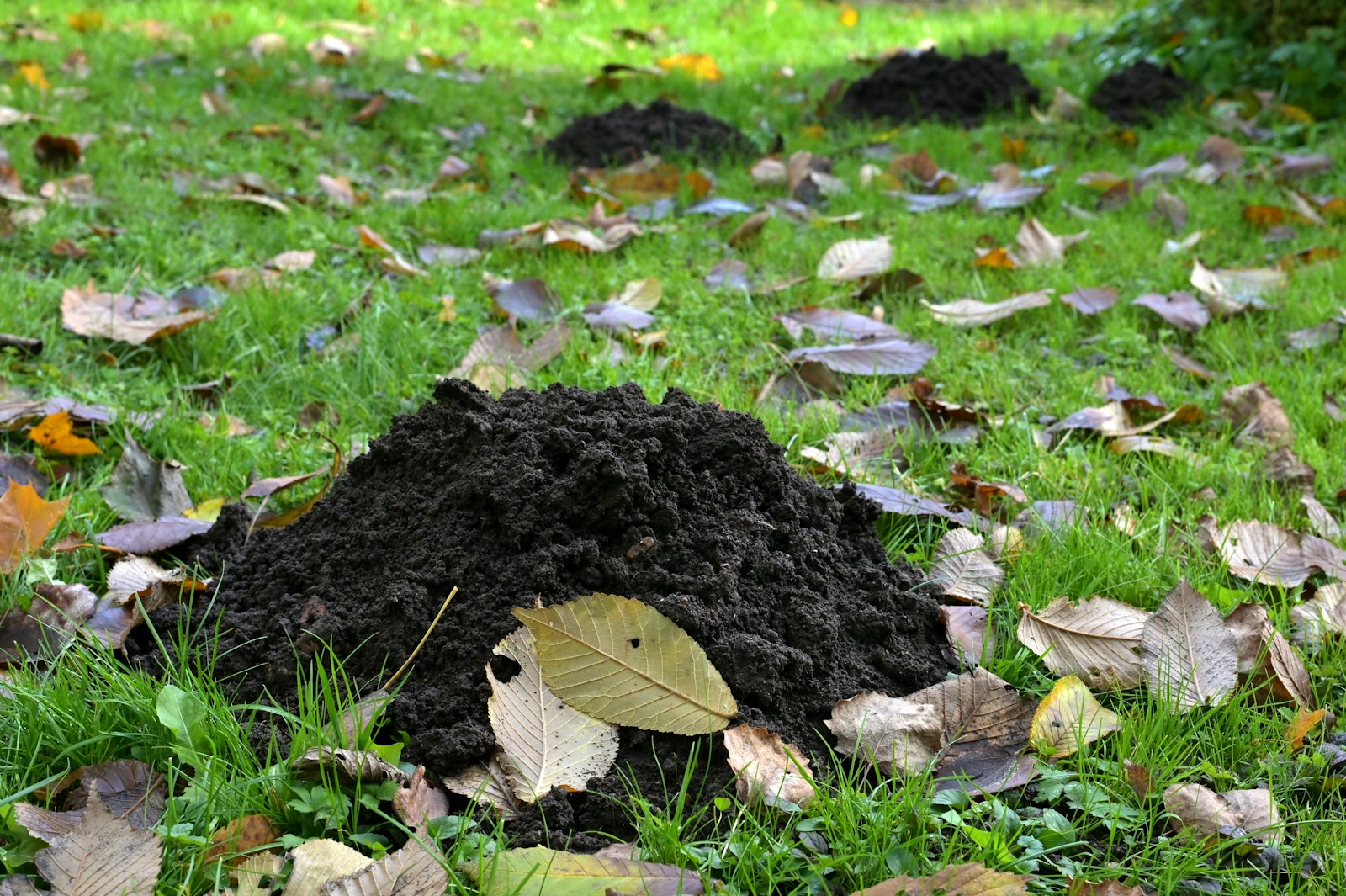

Every year around the first hard freeze the calls slow down, and when they pick back up in March the same sentence comes out of half of them. The moles went away over the winter and now they are back. I understand why it sounds that way from the kitchen window. The molehills stop appearing, the lawn goes dormant and quiet, and then one warm week in late February the yard looks like somebody drove a garden tiller through it.
Nothing came back. The mole never left. It spent the winter four to sixteen inches under the frozen crust doing exactly what it does in June, and the only thing that changed was whether you could see the evidence from the porch. That distinction matters more than it sounds, because it decides whether you spend March fixing a lawn or spend February keeping it from happening.
Key takeaways
- Moles do not hibernate. Eastern moles stay active every day of the year, including through snow cover and hard freezes in the Ohio Valley.
- A mole burns close to its own body weight in food daily and stores almost no fat, so a long dormant period would kill it. It cannot afford to sleep through winter.
- Fresh molehills stop appearing because the mole drops below the frost line into deep runways, not because it left the property or died off.
- Eastern moles breed in late winter, roughly February into March, so an untouched mole in January usually means a litter under the same lawn by April.
- Winter trapping works in Greater Cincinnati because our frost line is shallow and thaw windows are frequent, and it removes the adult before the spring population doubles.
Do Moles Hibernate in the Winter?
No. Moles do not hibernate and they do not enter torpor. The eastern mole found across Ohio, Kentucky, and Indiana stays active twenty four hours a day, year round, in roughly four hour cycles of digging, feeding, and resting. It simply moves its work deeper underground once the surface soil freezes.
Hibernation is a survival strategy for animals that can pack on fat and then run a low metabolism for months. Groundhogs are the local example, and they are very good at it. A groundhog can double its weight through the fall and then sleep off the entire winter in a chamber below the frost line, dropping its heart rate to a handful of beats per minute.
A mole cannot do any of that. It is a high output insectivore with a fast metabolism, a body built almost entirely out of muscle and digging hardware, and essentially no fat reserve to draw down. Left without food, a mole is in serious trouble inside of a day. That is not an animal that can afford to shut down for a season, and evolution never gave it the option. So it does the other thing available to a burrowing animal, which is to follow its food downward and keep working.
I have pulled moles out of runs in January with three inches of snow on the ground and a crust of frozen soil on top that you had to break with a spade. The animal underneath was fat, healthy, and completely unbothered by the weather eight inches above its head.
Where Do Moles Go When the Ground Freezes?
They drop into the deep tunnel system they already built. Every established mole territory has permanent runways roughly eight to eighteen inches down, well below the surface feeding runs. When the top few inches freeze, the mole abandons the shallow network and lives in the deep one until the ground softens again.
A mole territory is two systems, not one. The surface runs are the raised ridges you see cutting across the yard in spring and fall. Those are feeding tunnels, pushed just under the sod where worms and larvae concentrate, and a mole will abandon and re dig them constantly. Underneath that sits a permanent structure of deep travel tunnels, nesting chambers, and main runways that the animal uses for years and inherits from whatever mole held the ground before it.
Winter simply moves all the activity into the second system. The mole is not migrating anywhere. It is dropping a foot and continuing to patrol the same territory it patrolled in October, because that deep network is exactly the insurance policy it was built for. When we open a lawn in January to set traps, the deep main runway is usually right where it was in the fall, running along a driveway edge, a foundation line, a fence row, or a tree line.
Our region helps the mole here. Greater Cincinnati does not get the sustained deep freeze that Minnesota does. In a normal winter across Hamilton, Clermont, Boone, and Dearborn counties the frost line runs somewhere in the four to twelve inch range, and it retreats every time we catch a stretch in the forties. The mole is never far from workable soil, and it does not have to go deep to find it.
Why Do the Molehills Stop Showing Up in December?
Molehills are spoil from tunnels being dug near the surface. Once the mole is working deep soil, the dirt it excavates gets packed into old side tunnels instead of pushed up through frozen turf. The digging never stops. The visible byproduct of that digging does, and that is what homeowners read as the mole leaving.
This is the single most common misread I get on a winter site visit. A homeowner watched the hills stop appearing in early December, decided the problem resolved itself, and never thought about it again until the lawn came apart in March. Nothing resolved. The mole just stopped leaving receipts.
Think about what a molehill actually is. When a mole digs deep, it has to put the displaced soil somewhere, and the shortest path is straight up and out. That gives you the volcano of loose dirt on the lawn. When the top four inches are frozen solid, that exit is closed. The mole packs spoil back into abandoned runs instead, which costs it nothing and leaves you no sign at all.
Watch what happens during a January thaw and you will see the whole thing confirmed. Give us four or five days in the upper forties and fresh molehills appear on lawns that looked untouched since Thanksgiving. Those did not come from a mole that just arrived. They came from a mole that has been under that lawn the entire time and finally got soft enough ground to push spoil to the surface again.
If you are seeing raised surface trails during snow cover rather than dirt mounds, that is usually a different animal. Voles run at the soil surface under snow and leave narrow chewed pathways in the turf when it melts, which is a separate problem with a separate fix. We covered the difference in moles versus voles and how to tell them apart.
Do Moles Still Eat in Winter, and What Are They Finding?
They eat constantly all winter, mostly earthworms. Earthworms retreat below the frost line when the soil cools, and the mole follows them down. Grubs and insect larvae round out the diet, but earthworms are the bulk of it in our soils, and they are the reason a mole can feed through a January cold snap.
A mole eats enormous amounts relative to its size, generally in the neighborhood of its own body weight every day. There is no version of that appetite that pauses for weather. The good news for the mole, and the bad news for your lawn, is that its primary food does the same thing it does. Earthworms move deeper as the soil cools and stay active well below the freeze, which means the food supply relocates rather than disappearing.
That is worth understanding because it kills a common assumption. Plenty of homeowners believe a mole problem is a grub problem, and that treating for grubs will starve the mole out over winter. It does not work that way in our region. Earthworms carry the diet, grubs are a supplement, and a lawn with zero grubs and healthy worm activity will still hold moles. We wrote about that in more detail in what ground moles actually eat, and it is the reason grub control alone is not mole control.
Rich, worked, well watered ground holds more worms, which is why the nicest lawn on the street is so often the one with the mole problem. Established neighborhoods across Cincinnati, Anderson Township, Florence, and Lawrenceburg with decades of built up topsoil are prime winter feeding territory, and the mole has no reason to look anywhere else.
Do Moles Breed Over the Winter?
Yes, and this is the part that costs homeowners the most. Eastern moles breed in late winter, generally February into early March in our area. After roughly six weeks of gestation a single litter of two to five young arrives in spring. One tolerated mole in January routinely becomes several tunneling animals by May.
Moles are solitary and territorial for most of the year. A single adult will hold a surprisingly large piece of ground, often an acre or more, and that is why a badly torn up lawn is frequently the work of one animal rather than a colony. The exception is the breeding window, and that window sits right in the middle of the season when everyone has decided the mole problem went away.
Males extend their deep runways during late winter looking for females, which is one reason a property that seemed quiet can suddenly show activity in odd places in February. Young are born in the nesting chamber in spring and are on their own within about a month. Once they disperse they need territory, and the nearest good soil is the lawn they were born under and the two lawns next to it.
So the March surge that feels like an invasion is usually not new moles moving in from the woods. It is the litter that was conceived under that same yard in February, coming up into workable soil and spreading out. Every winter we leave an adult in place, we are choosing the spring that follows it.
Is Winter a Bad Time to Trap Moles in Cincinnati?
It is a good time here, and often the highest value time of year. Our frost line is shallow and thaw windows are frequent, so deep runways stay reachable. Removing an adult in January or February takes out a breeding animal before the spring litter, which prevents damage rather than repairing it.
Winter trapping is different work, and it is genuinely harder to do well. The surface runs that make a summer job straightforward are abandoned and useless, so a set based on visible ridges will catch nothing. The whole job moves to locating the deep main runway, which means reading the property instead of reading the lawn. Fence lines, driveway and sidewalk edges, foundation walls, tree rows, and the low side of a slope are where those permanent travel tunnels tend to run, and they hold up under frozen ground.
Set placement has to be precise, because in winter you get fewer chances. A mole patrolling deep runs still passes through the same choke points several times a day, but there are far fewer active runs to choose from and no fresh surface sign to confirm you picked the right one. That is a trapping skill problem, not a weather problem. If you want the full picture of how the sets work, we laid it out in our guide to ground mole trapping.
What you get in return is leverage. In June you are removing a mole and the damage is already done. In February you are removing a mole before it produces a litter and before the spring feeding push tears the turf apart. Same animal, very different outcome. We walked through the seasonal tradeoffs in more depth in spring versus fall timing for mole removal, and the same logic argues for not waiting out a winter.
What Does Winter Mole Activity Do to a Lawn by Spring?
The tunneling continues under the frozen surface all season, so the damage accumulates invisibly. When the ground thaws you get collapsed runs, spongy soft turf underfoot, root systems separated from soil, and dead streaks that green up weeks behind the rest of the lawn. Spring does not create that damage. It reveals it.
Moles do not eat grass roots. The damage is mechanical. A tunnel pushed under the root zone lifts the turf off the soil, and grass with air under its roots dries out and dies even in a wet spring. Multiply that by a winter of daily tunneling under a lawn nobody was watching, and you get the pattern we see on site visits every March.
The tell is walking the yard after the thaw. Ground that gives underfoot, edges that sink along a walkway, and irregular brown ribbons that stay brown while everything around them greens up. Those ribbons trace the winter runs almost exactly. On sloped Cincinnati lots the freeze and thaw cycle makes it worse, because a collapsed tunnel on a grade becomes a channel that carries water and takes soil with it.
Repair is possible and it is not complicated, but it is a season of work you did not need to do. Rolling, top dressing, and reseeding a lawn that spent the winter being undermined costs more time and money than removing one animal in January would have. If you are already past that point, our winter mole damage prevention tips cover what to do while the ground is still cold.
Should You Wait Until Spring to Call About Moles?
No. Waiting for spring means waiting for the breeding season to finish and for the visible damage to arrive. If you saw mole activity in the fall, the animal is still on the property in January. Handling it in winter removes one mole instead of a family and protects the turf you have.
The instinct to wait is understandable. Nothing looks wrong in January, the lawn is dormant, and it feels like a problem for later. But the calendar works against you in a specific way here. Later means after breeding, after a winter of tunneling, and after the turf damage is already in the ground waiting to show itself.
There is also a practical reason not to sit on it. When spring arrives and every lawn in the neighborhood shows fresh activity at once, the schedule fills up fast. Winter is when we can get to a property quickly and take the time to locate deep runs properly instead of working through a backlog.
Our professional mole removal service covers Greater Cincinnati across Ohio, Kentucky, and Indiana, and mole work is what we do first and most. We are A plus rated with the BBB, we guarantee the removal, and we trap rather than pushing products at a problem that products do not solve. If you are inside Hamilton County, our Cincinnati mole trapping page has the local details. If you want to understand the removal approach before you call, start with how to get rid of moles in your yard.
Call 513-518-5639 and get a free phone estimate, no sales visit needed. Tell us what you saw and when you saw it, and we can usually tell you over the phone whether you are dealing with one established adult or something that has already spread.
Common Questions
No. Winter cold does not kill an established mole in our region, because the animal is living below the frost line where soil temperatures stay stable. Young moles dispersing in spring face real mortality, but an adult holding territory under a Cincinnati lawn in December is very likely to still be there in March.
Deep runways generally sit about eight to eighteen inches down, and moles use those all winter instead of the shallow feeding runs near the surface. In a mild Ohio Valley winter they often work far shallower than that, because our frost line is not deep and it retreats during every warm stretch.
A thaw softened the top few inches, so the mole could push spoil to the surface again. It has been tunneling under that lawn continuously. The molehills are not evidence of a new arrival, they are evidence that the ground finally let the same animal do visible work.
Yes, and we do it every winter across Ohio, Kentucky, and Indiana. Sets go into the deep main runways rather than the surface runs, so finding the right run matters much more than it does in spring. It takes longer to locate, and the payoff is removing a breeding adult before the litter arrives.
No, and the two animals are opposites in this respect. A groundhog fattens up all fall and truly sleeps the winter off underground. A mole carries almost no fat, has to eat close to its own body weight in worms daily, and would starve in days if it tried the same thing.
Photo by Andres Siimon on Unsplash.